April Seminar 2020

Artist’s Statement:

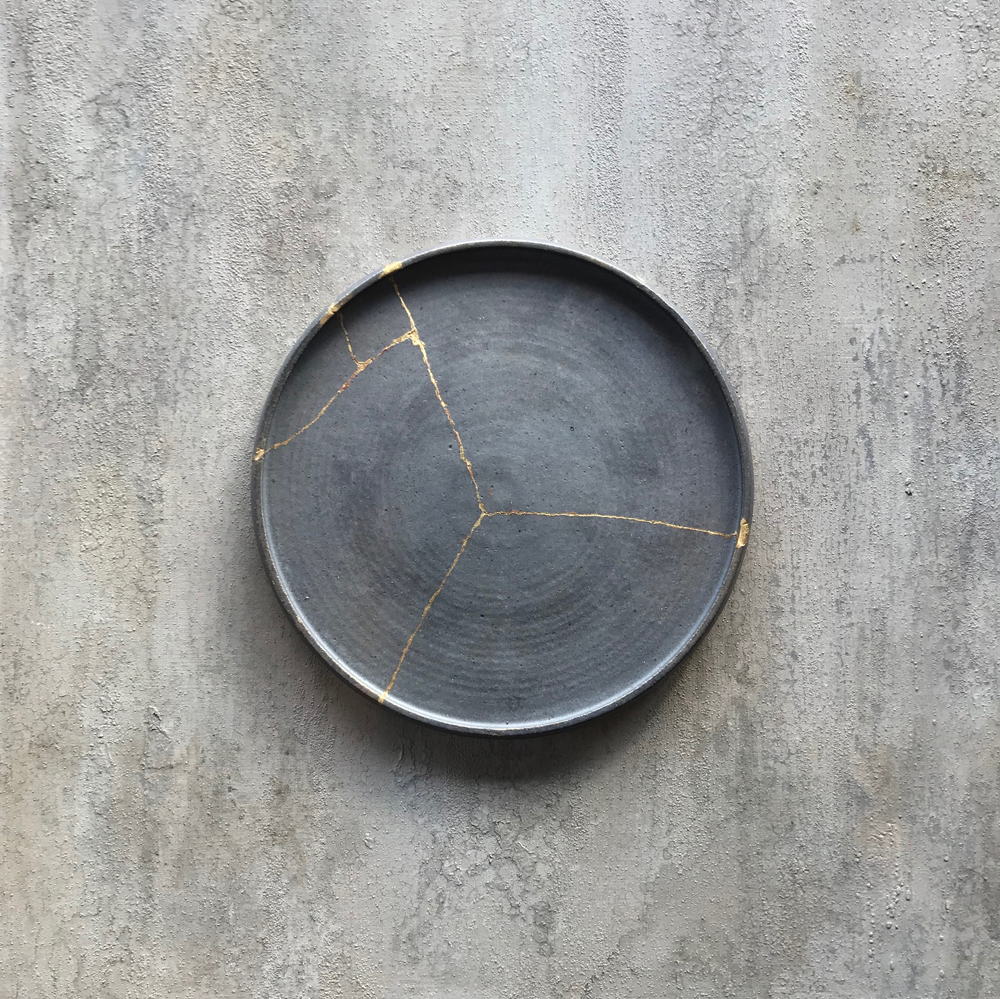
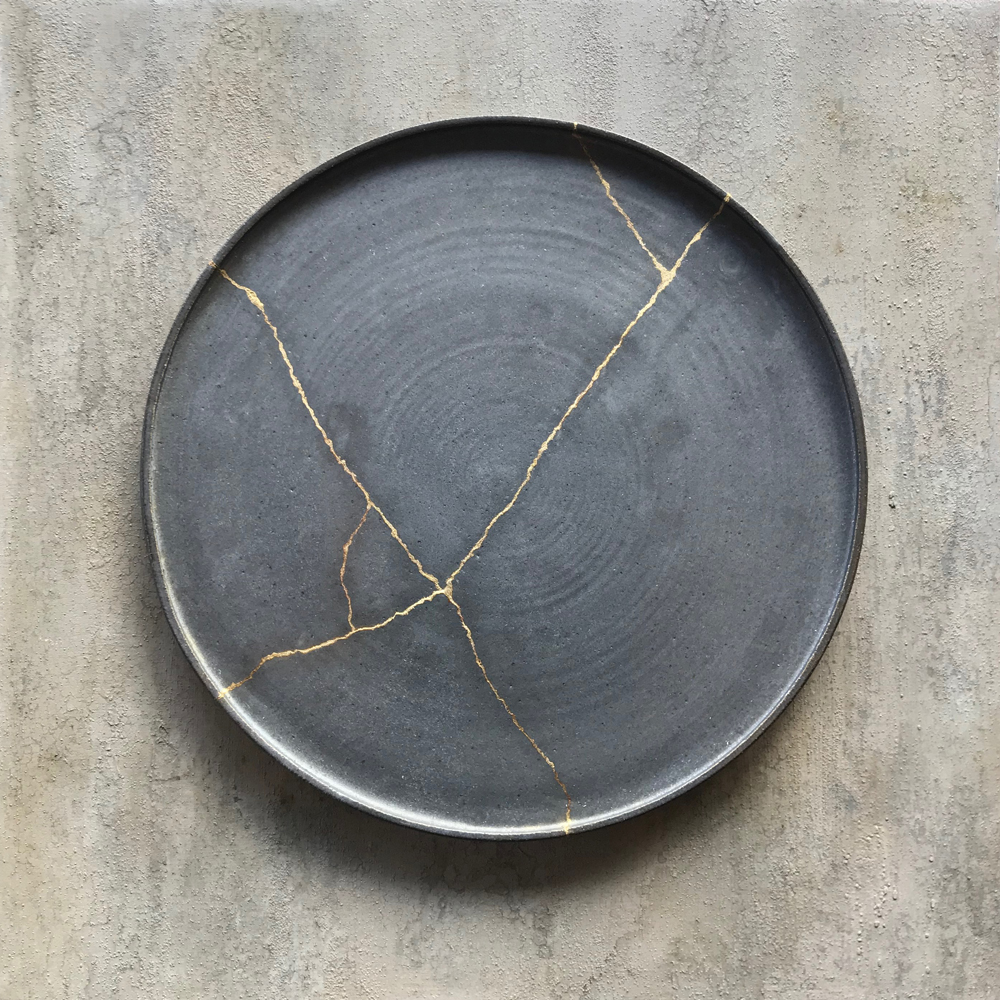
Abbie Read, Solicited collaboration: Alchemy I. [Fiona MacKay stoneware plate, epoxy resin, urushi lacquer, gold powder. 200 x 200 mm]. 2020

An undoing. 
A wound, a healing.
Opulent scars.
Symmetry erased, raisin d’être supplanted.
A transmutation; an alchemy; an acculturation.
Journeying to the borders of permissibility; 
the act of destruction as creation.
An amending and mending of another artist’s work; 
the very act of which smudges orderly lines of authorship.

Ordinarily, a broken object is perceived as worthless, yet with craftsmanship, time and the incorporation of precious metal, it is honoured and made more valuable. 

In the Japanese tradition of Kintsugi, fragmented crockery is not only reconnected but transmuted from utilitarian commodity to unique artefact thus rendering it invaluable.

Kin’ means ‘gold’. ‘Tsugi’, ‘to bond or connect’; not only pieces but people, cultures and their shared histories.

Born in Britain, as was I, New Zealand ceramicist Fiona Mackay creates Japanese style stoneware with clay originating from South Korea. A professional artist in her own right, her exquisite pieces are fully functioning artisanal ‘readymades’.

As we utilise the techniques and materials of another culture, we negotiate our ethical right to do so: Korean clay and Japanese processes wielded by European hands on antipodal soil; Each nation has moulded and shaped the other in an unsolicited collaboration, a complex acculturation and precious entanglement; a transmutation of its own.

As I take ownership of Fiona’s work, and break and mend it, the boundaries of definitive authorship also fracture. With the simple addition of a process or material, I have made it more mine. This too is an assimilation of culture; the overlaying of one artist’s practice over another’s; a colonisation of sorts.

What are ceramics, but moulded clay; shaped earth? In Christian doctrine, Genesis depicts humanity forged from earth. Clay is but damp dust. Dust to dust. It speaks of the temporal nature of all things, both animate and non; the eventual dissolution of all matter.

Le roi est mort, vive le roi!’

Notes from the studio

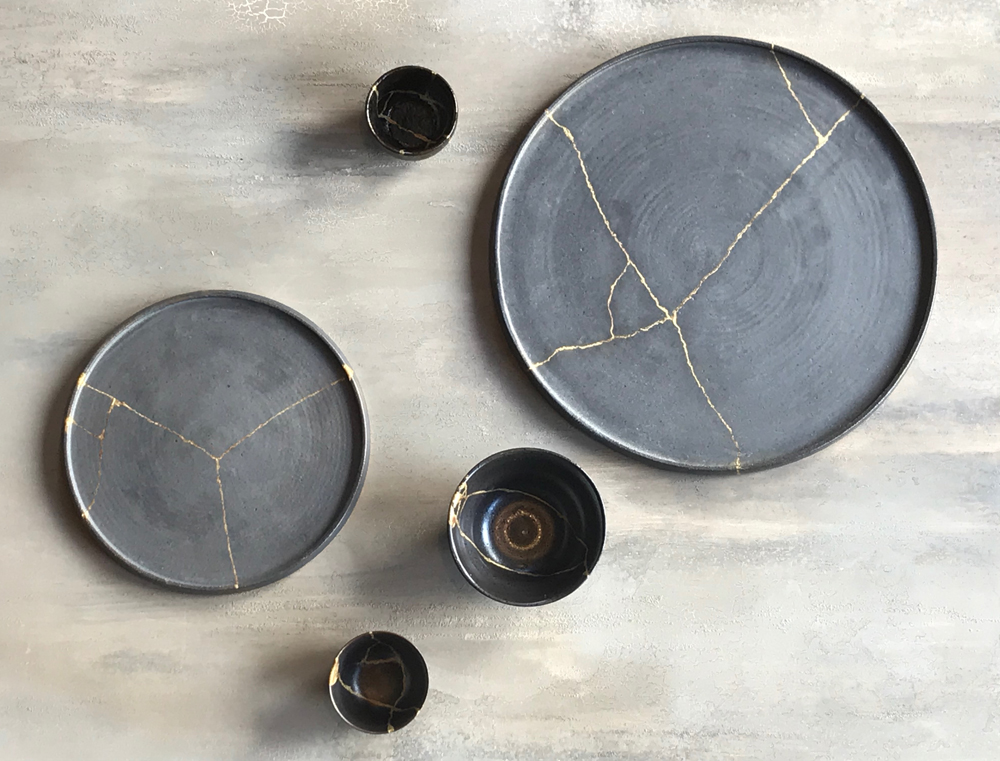
Abbie Read, Solicited collaboration: Alchemical assemblage. [Fiona MacKay stoneware plates, commercially produced chawan tea bowls, epoxy resin, urushi lacquer, gold powder]. Dimensions variable. 2020

In essence, these works are about: value systems, generative and degenerative processes, cross-cultural appropriation, and the rights bestowed by ownership and authorship.

The role of the object has evolved from utilitarian to merely decorative. Are ornamental objects necessarily ascribed more ‘value’ than more useful ones?

There are several value systems at play here:

  • The commercial price-tag of the unaltered plate
  • The perceived ‘worthlessness’ of an object broken
  • The added monetary cost of a precious commodity such as gold
  • The uncounted hours of care, of craftsmanship
  • The inestimable worth of a now unique item
  • The value inferred and conferred by displaying such an item

Gold adornments can be ostentatious. These are modest and unpretentious. It is the assemblage of a treasure, a taonga, not a flashy materialistic commodity. Its beauty lies within its imperfections. It carries its history in proud scars. Its worth cannot be measured in carats but in time and care taken. Work such as this cannot be achieved by machine. It requires an artist’s hand.

Abbie Read, Solicited collaboration: Alchemy II. [Fiona MacKay stoneware plate, epoxy resin, urushi lacquer, gold powder. 200 x 200 mm]. 2020

Additional considerations of using handmade over commercially manufactured ceramic ware:

Looking closely at the surface, slight indentations may be seen that document the fingertip pressure points of the artist’s touch. A series of these bespoke plates are fraternal iterations: however closely they resemble each other, they are in essence non-identical.

Commercial crockery – a succession of perfect clones, lacks the soul and evidence of authorship provided by ‘the hand of the artist’.

(Additionally, as a practical consideration, handmade ceramic ware tends towards more random and natural fracture lines, which is preferable and certainly more aesthetically pleasing.)

The structural breakdown though artificially managed, defies rational order and manipulation to create its own organic fractured composition. The control and taming of the natural world remains an elusive fallacy.

If perfection is merely adhering as closely as possible to an original archetype, then factory produced pieces would be the pinnacle of desirability.

In The Stones of Venice, Vol II, Ch. 6, the art critic John Ruskin maintained that, “no good work whatever can be perfect, and the demand for perfection is always a sign of a misunderstanding of the ends of art.” Also asserting that “imperfection is in some sort essential to all that we know of life. Nothing that lives is, or can be, rigidly perfect; part of it is decaying, part nascent.” 

(Ian Baucom, Out of Place: Englishness, Empire, and the Locations of Identity (Princeton: Princeton University Press, 199), 65.)

As the plate is shattered, so too is its utility. It has become a ‘still life’. 

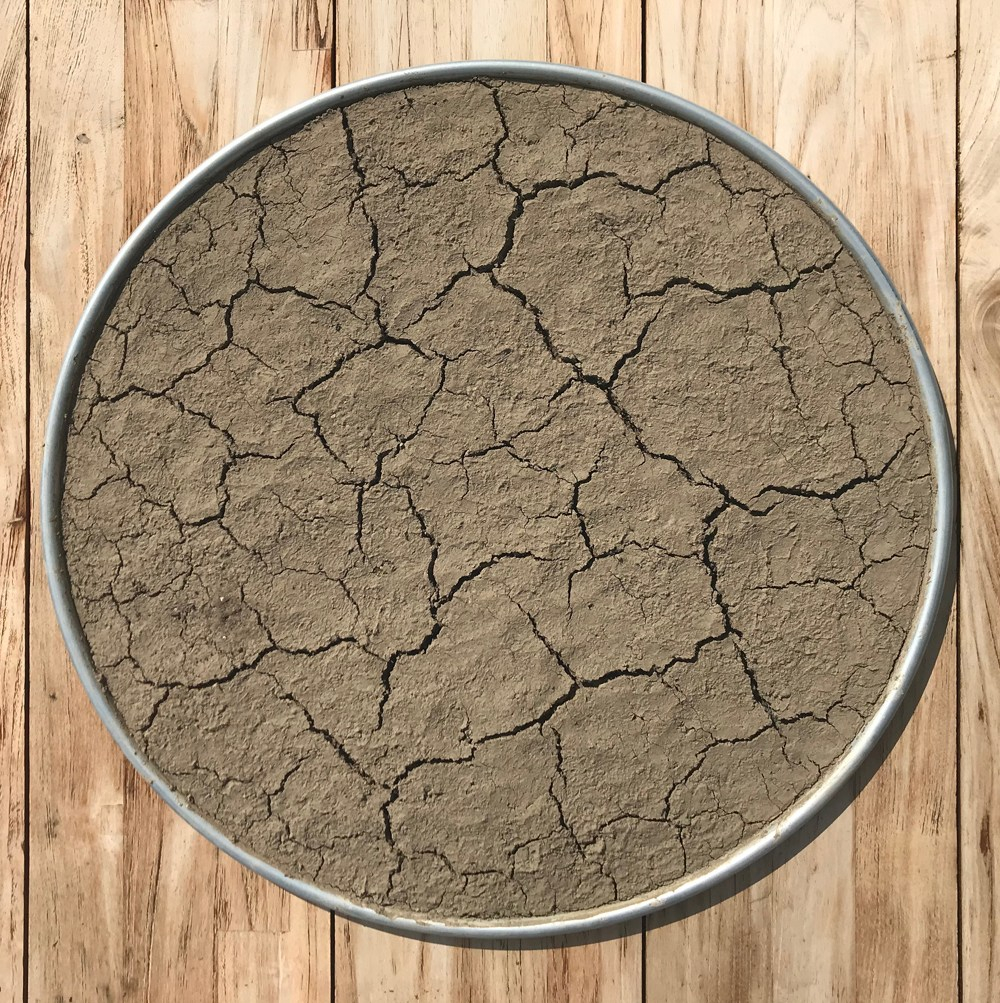
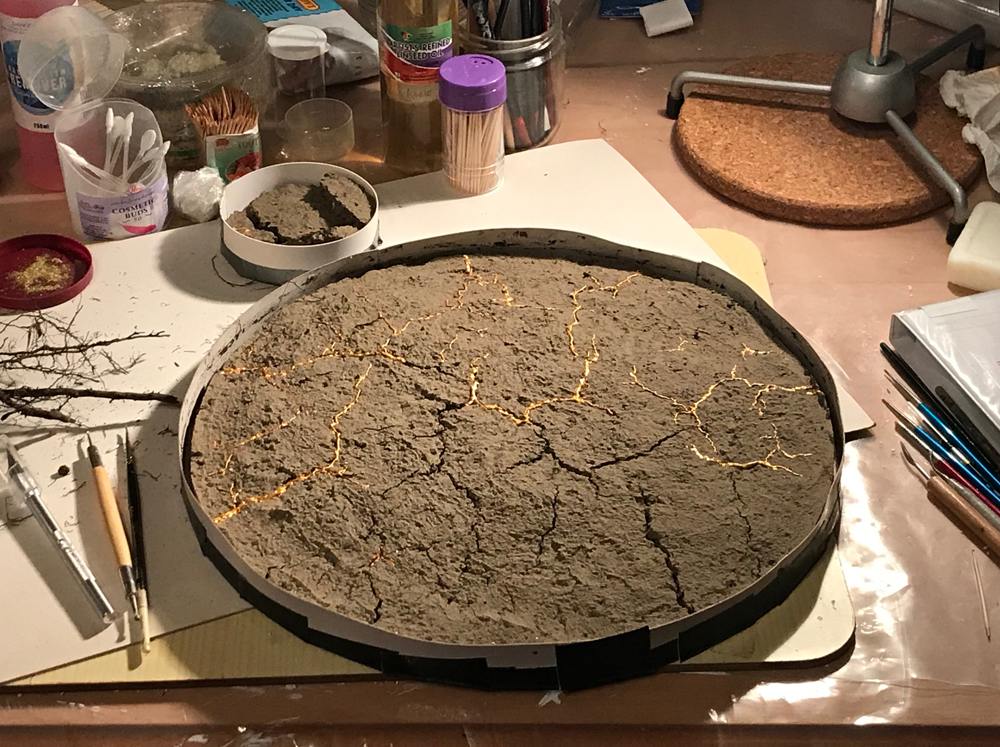
Abbie Read, Studio photo of large cracked earth piece. 580 x 580mm. March 2020

I am interested in how earth (with and without a capital letter) is valued. I have been exploring the materiality of mud and how it reacts under stress. Clay, like earth and sand, is specific to its own habitat; its constitution, an archive of its particular domain.

Fostering a deeper understanding of the natural world, its organisms, ecosystems and the underlying mutualistic relationships, is becoming more imperative than ever in our pandemic-compromised, latterly climate-change aware, natural resource depleted global environment.

Abbie Read, Studio photo of cracked earth kintsugi piece. 350 x 350mm. March 2020

Cracked earth: a wound. I have been ‘mending’ the fissures with kintsugi; healing the ‘earth’ with time, labour and precious resources. 

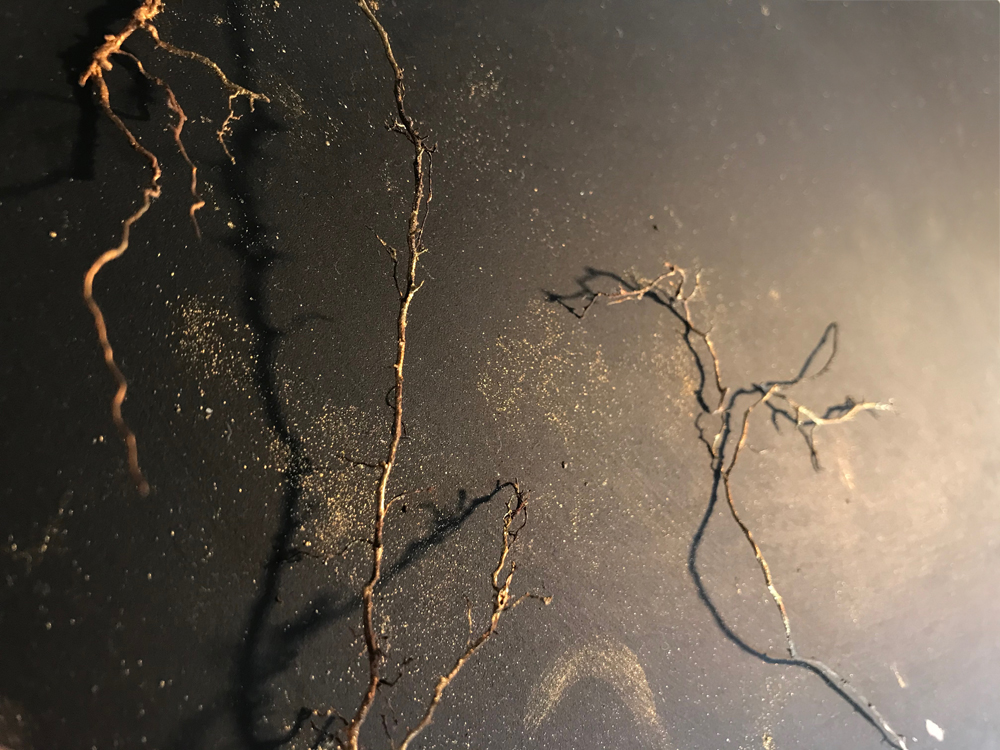
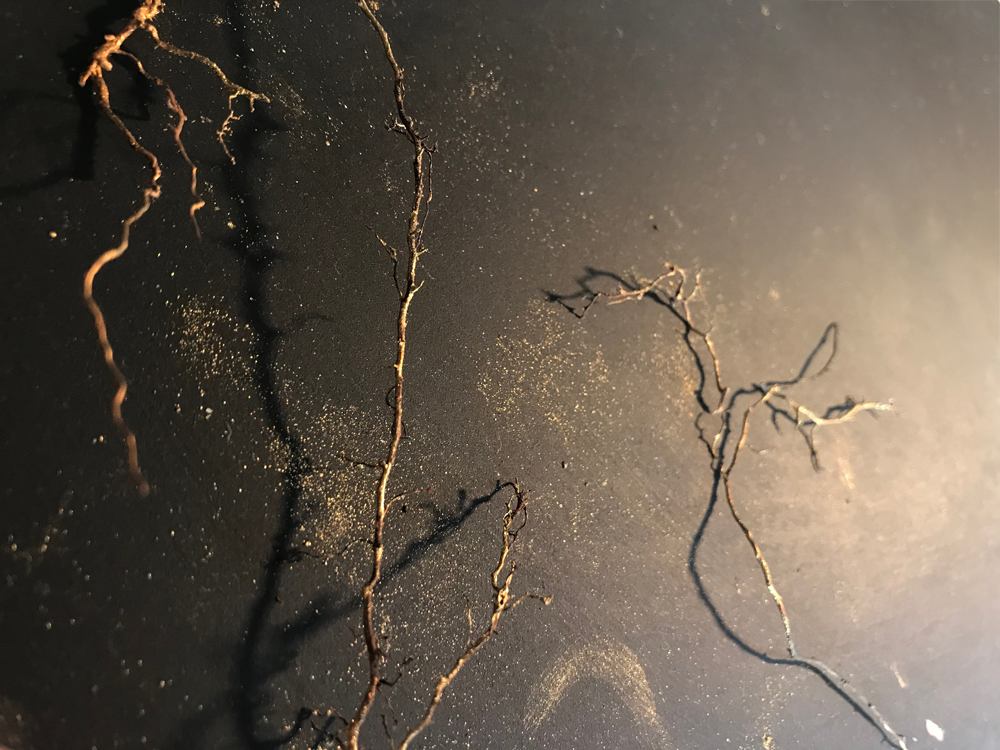
I am also interested in the unseen; the interconnecting structures that bind, mirroring the golden veins of kintsugi, which now link the previously disparate pieces.