Critical reflections (April)

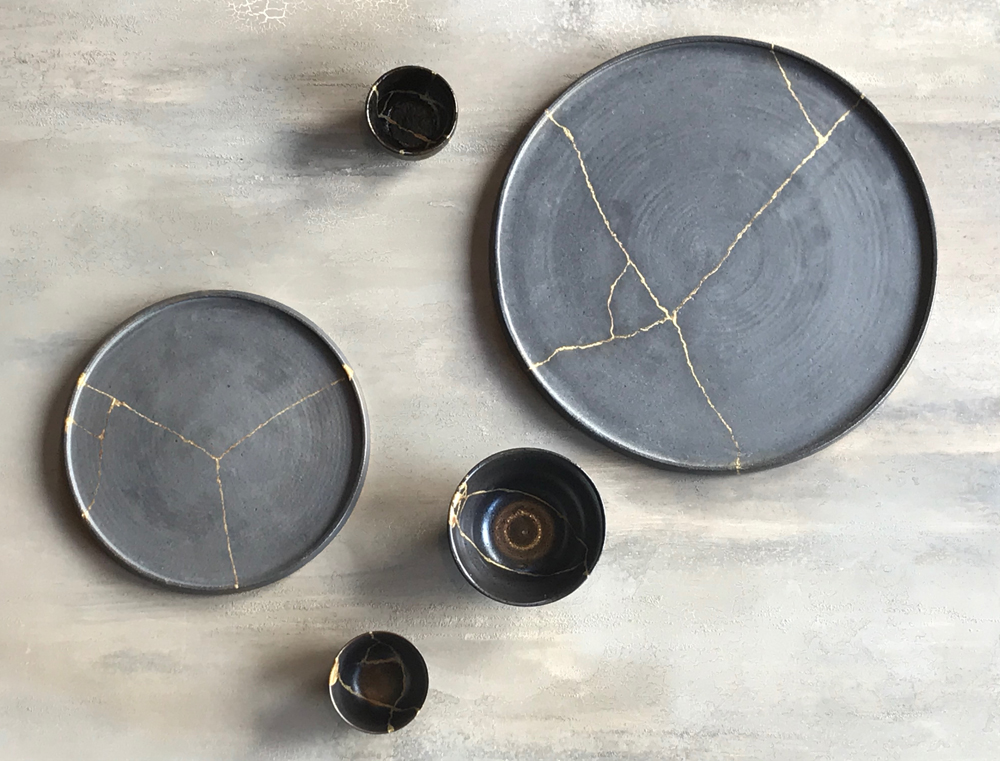
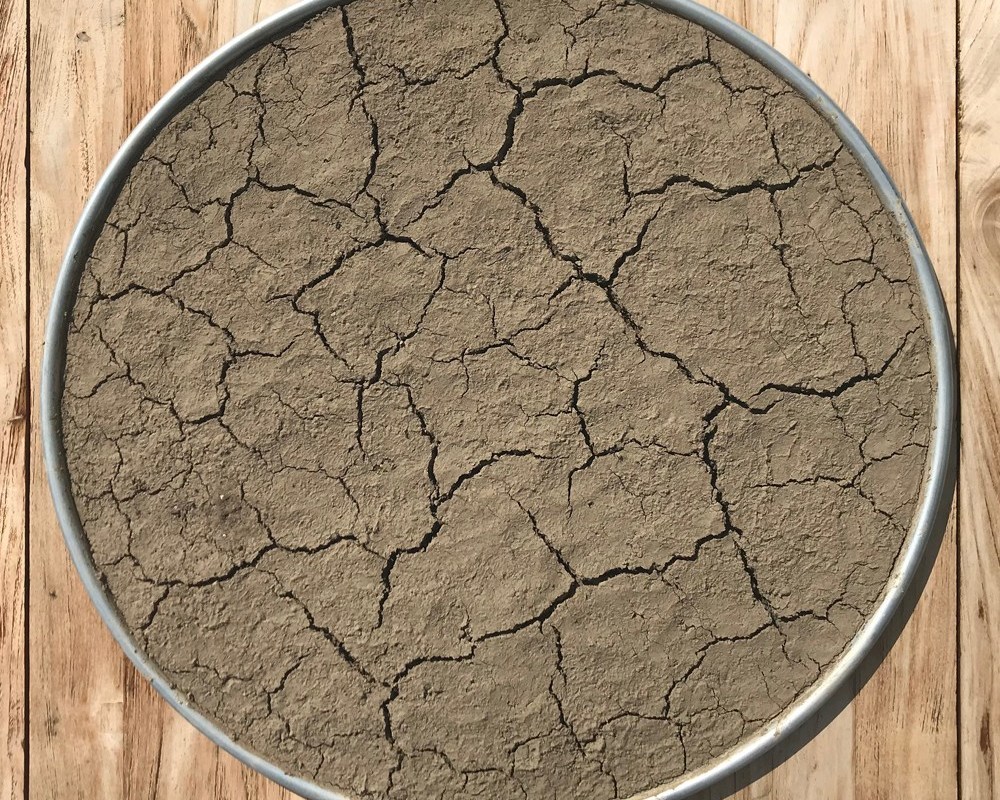
My central point of fascination was about ownership and authorship and the taking over of another artist’s artworks or practice. Listening to the critical responses, I can see that many people felt more engaged by the cracked earth discs on my studio bench than by the finished Kintsugi piece. 

The constraints of Covid lockdown meant that all artworks were necessarily displayed via digital photography (or video) online. I presented my kintsugi piece [Alchemy I; unsolicited collaboration, 2020] as being a physical object mounted upon a distressed grey wall (that therefore highlights the natural forces of entropy inherent in all things and removes the piece from the stark white gallery context).

Although, when viewed online, it would have remained identical, on reflection I feel that the piece operates more successfully as a photographic work than as a displayed physical object, in both aesthetic and conceptual terms; as it is the idea of the piece rather than the piece itself which is the more important consideration. To further the ideas of ownership and authorship, it would be interesting to commission a professional photographer to take the image that is ultimately displayed as the finished piece. By involving a third artist in a third medium, with each of us in collaboration overlaying each other’s art practices, I think the resultant artwork is made stronger.

I think Alchemy I; unsolicited collaboration was very lineal and literal in its translation from idea to tangible object, and as such suffers from leaving little room to breathe; the art piece and the ideas within it are closed down too quickly. I value and enjoy the interlaced layers of meaning I find behind and within the piece but perhaps viewers need some room to formulate their own associations and prefer a tad more ambiguity. At present I find it difficult to conceive of a way to make artworks addressing the theme of taking over another artist’s practice in a more abstracted way. But I would like to come back to this theme in a few years when my understanding of my own art practice has grown and matured.

Feedback from the faculty, cohort and guests:

People responded well to the idea of the earth being borrowed and it potentially being returned to the roots of where it was borrowed from, in its own form of ‘unsolicited collaboration’. There was also a response to the image of the cracks in the earth and the golden roots as having a healing association; perhaps even relating to the self and the therapeutic mending of perceived imperfections.

Questions were asked about the types of object that traditionally might get mended; which is an interesting consideration. The material context of gold was remarked on and it being both a mineral and a commodity. It being the literal standard to which currencies are measured against. It therefore signifies a particular kind of security.

Arte Povera (and its utilisation of limited resources) was mentioned as too Ai Weiwei’s artwork: 
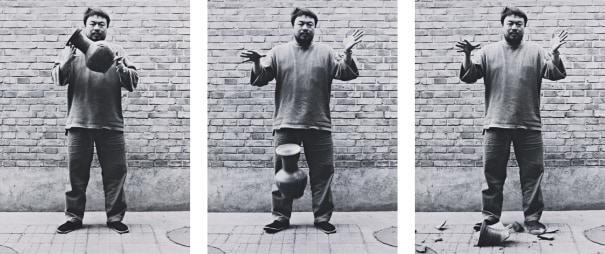
Ai Weiwei, Dropping a Han Dynasty Urn, [Triptych: black and white photograph]. 1995.

His radical act being part performance, part political commentary on cultural worth, symbolic power and historical value systems.

The idea of fissures resembling thread-like root systems (as seen in my studio in their early stages) seems to be fertile territory for further exploration.

We discussed containment: mud banks, wood (as seen in the background of one of my photos) often used as a structural containment device). Also we talked about relation to site. That an artwork need not necessarily take place within a gallery context. It might exist in the community or within the same place as the material was originally sourced from.

An idea was suggested that I might consider ‘guerilla kintsugi pothole filling’ (mending broken urban pathways in the community with gold). This has however been done: 
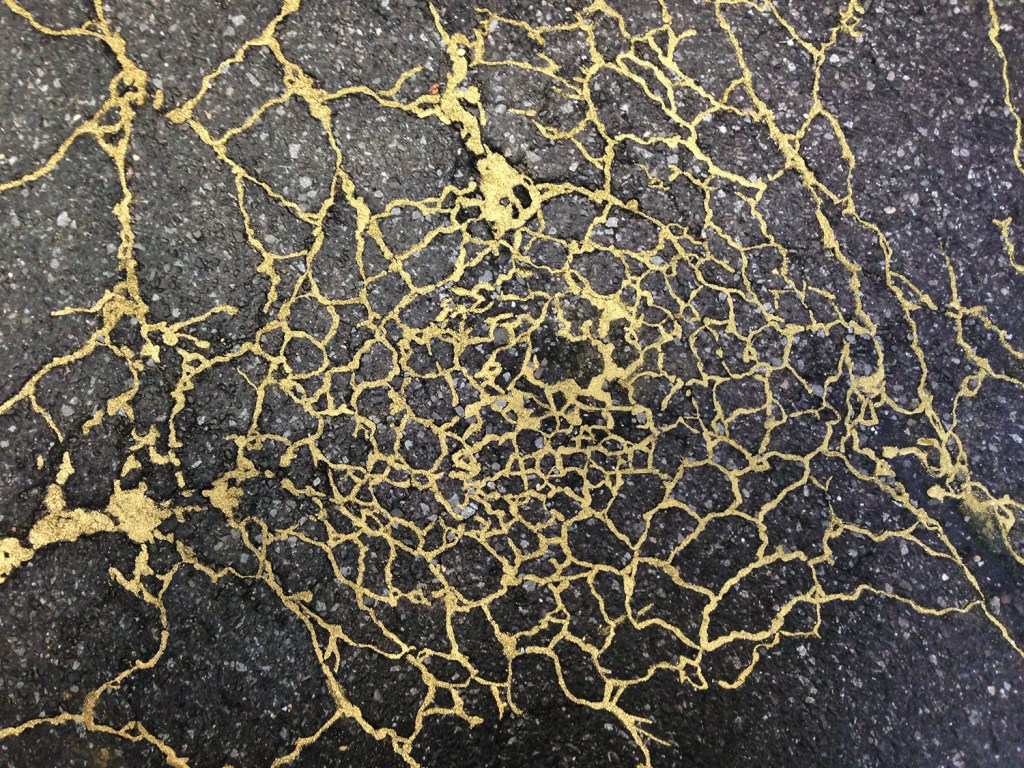
Rachel Sussman, Study for Sidewalk Kintsukuroi #01 (New Haven, Connecticut), [photograph with enamel paint and metallic dust]. 

The circle was thought to be representative of Mother Earth and of the Earth being under enormous stress and the action of mending with gold, a healing process.

Some viewers found the aspect of having both the breaking and mending within the same piece to be a bit confusing; a complication; an anomaly.

Another artwork was mentioned in relation to the mark of one author overwriting another: Rauschenberg’s erased de Kooning drawing (1953). I watched a (sadly uncredited) interesting interview with Rauschenberg about this piece. (https://www.youtube.com/watch?v=tpCWh3IFtDQ). Apparently it was really difficult to erase and took two months to do so. He described it as poetry, not vandalism.

I found it very interesting to note that as he was stealing up the courage to ask de Kooning for an artwork of his to erase, he was prepared for his own idea to ‘fail’ and maybe the failure itself would be the artwork. Maybe the artwork would be about asking de Kooning if he could erase a picture, and that would be okay. Maybe the process itself is the artwork instead of a finished displayed object.

Talking things over with my supervisors it is agreed that I should experiment with not knowing; experimenting with no up-front rationale for the series of choices made. To put concepts to one side and explore. 
Practice Statement

Abbie Read, Work in progress: mud disc I, April 2020.

Oft unnoticed or dismissed, I am endlessly entranced by the slight or negligible; objects seldom considered of value or beauty; items seldom considered as objects at all. 

I work with mostly natural materials: wood, earth, clay, mould and bacteria, utilising their materiality and innate associations to explore notions of contextual value and of life, still life and the absence thereof.

At present, I am contemplating generative and degenerative systems, both natural and enforced, and their inter-relational entwinings. My predilection lies towards Negentropy; a fascination for the natural processes of decay, interwoven with a desire to analyse and preserve. In so doing I inevitably order the chaotic, and perversely halt the living, mutable entity which first enticed me, in order to capture and immortalise its essence.

I am an observer, a collector and assembler; Artist as witness, compiler and instigator. I am interested in the practice and politics of display and the necessarily judgemental protocols which expressly determine what gets preserved or exhibited and how.

I enjoy the physicality of ideas made manifest; an embodied entanglement of symbiotic concepts and considerations. I am also drawn to what is not embodied; the interstitial space, the silence, the absences.

The aesthetics of my practice align with much of what is understood as the philosophy of Wabi-Sabi; a subtly intangible Japanese ideology which finds value in the simplicity of natural imperfections. It speaks to the delicate traces of impermanence and expounds that “the closer things get to nonexistence, the more exquisite and evocative they become.” (Koren, Wabi-Sabi for Artists, Designers, Poets & Philosophers, 50.) 

This viewpoint is shared by the Victorian art critic John Ruskin who also observes a certain sublimity in the monotonous or mundane and exclaims that “to banish imperfection is to destroy expression, to check exertion, to paralyse vitality. All things are literally better, lovelier, and more beloved for the imperfections which have been divinely appointed.” (Ruskin, On Art and Life, 27.)

I have been looking at the works of land artists such as Andy Goldsworthy, in particular his works with earth and clay. These pieces often acknowledge time and change as being connected to place. He asserts that “the challenge has been not simply to wait for things to decay, but to make change an integral part of a work’s purpose so that, if anything, it becomes stronger and more complete as it falls apart and disappears.” (Goldsworthy, Time, 7.)

The artworks of Pauline Rhodes and Charlotte Prodger also recurrently relate to the passage of time, within a specific environmental context alongside temporal traces of particular events and encounters.

Currently I am being more experimental in how I approach my art making, letting the materials speak and breathe in lieu of being prematurely and prescriptively tied to particular imposed meanings and interpretations. I am learning to bathe in the liminal, not race to encase the finite. Though this I find, is a delicate balance as it is always the coalescing of the myriad flickering ideas that sparks my joy in the creative process. 

References:

Leonard Koren. Wabi-Sabi for Artists, Designers, Poets & Philosophers. Berkeley: Stone Bridge Press, 1994.

John Ruskin, On Art and Life. London: Penguin Books, 2004.

Andy Goldsworthy, Time. London: Thames and Hudson, 2000. 

Christina Barton, Ground/Work: The Art of Pauline Rhodes. Wellington: Adam Art Gallery & Victoria University Press, 2002.

Tateshots, Charlotte Prodger: Turner Prize Winner 2018: Tate Shotshttps://www.youtube.com/watch?v=AsVWk5DlbCE

Studio visit May 2020

Dane and I conversed about the value of proper archiving and possible digital online systems that might achieve this. 

There was a valuable discussion about the languaging surrounding the concept of ‘beauty’ and it being a complex and loaded subject area probably best evaded at present. In particular, while assessing the merits of a kintsugi-ed mud disc, we decided it was more pertinent to describe the piece as ‘not operating effectively’ rather than in terms of its beauty or absence thereof. 

On recommendation, I am ordering a copy of Dave Hickey ‘The Invisible Dragon: Essays on Beauty, Revised and Expanded”

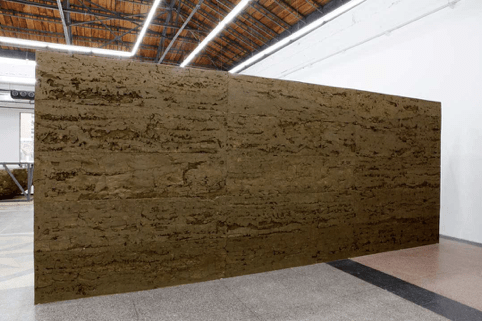
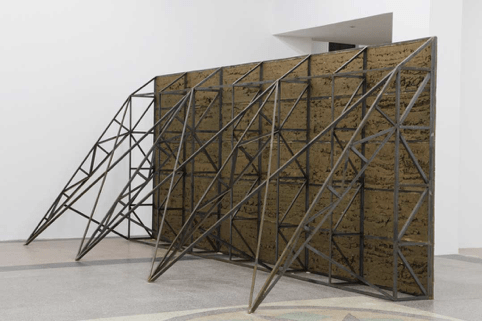
Dane explained his affinity to G-clamps as both reference to the actions of construction (joining, pressing, containing) and as architectural objects in their own right. We looked at the work of Karsten Födinger with regards to containment systems and devices; his work showing the traces of action or event embedded within the art object itself, and a truth and simplicity of materials, often employing industrial forms of support or containment.

Karsten Födinger, Fluvial Yingbi, 2015, steel, soil, 246 x 600 x 203cm.
Installation view: Antenna Space, Shanghai, China

We also talked of my search for tree stumps to use as a raw material for yakisugi – a Japanese technique of charring wood in order to add value (aesthetic, utilitarian and monetary) by increasing water-resistant and fire-retardant properties thus enhancing its longevity and preservation. 

Studio works were mostly in the following categories: 

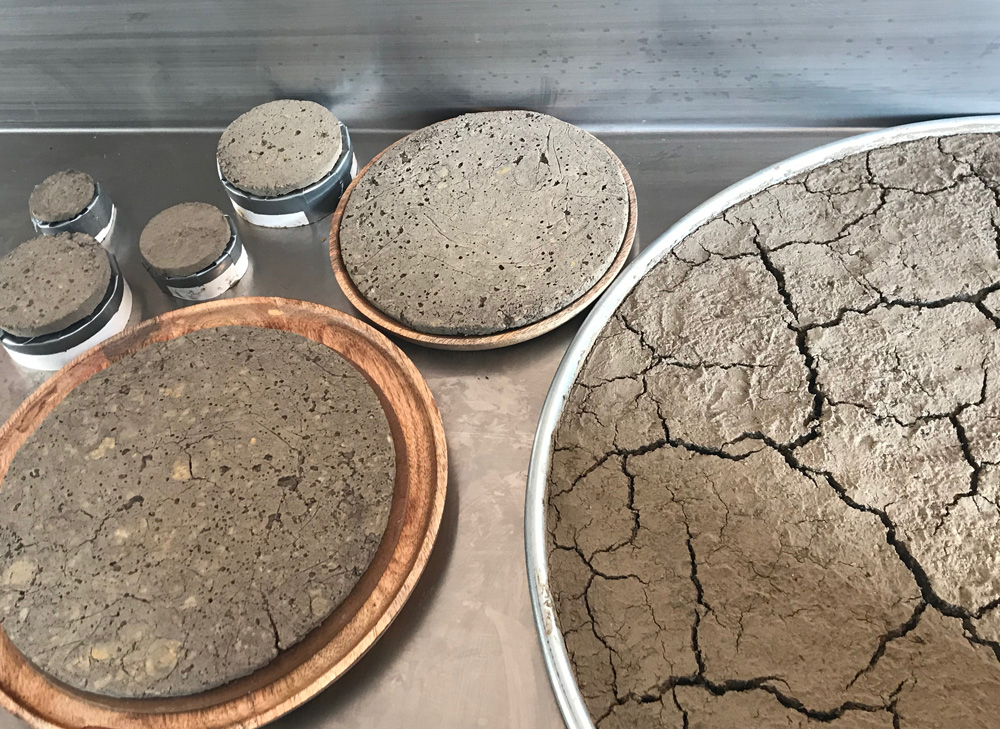
  • More dried mud discs, with particular focus on the cracks and fissures. 
Abbie Read, mud discs in progress, May 2020

We discussed the practicalities of casting these discs in different materials. Plaster might well dissolve the dried mud and intermingle with it producing a less than optimal result. A casting latex might work well – more research required. We also discussed the possible use of concrete as both a casting medium and end product; it having more pertinence to my field of interest than plaster.
I appreciate the utility and solidity of concrete, and its use as a building material and containment device. I like the fact it is both ancient and modern and an amalgam of both the natural and manmade worlds. It is also subject to stress cracks of its own which could prove fruitful research-wise.

Dane posed the question of whether I might be keen to use specifically synthetic materials. I will ponder more on this but my initial response would be that it isn’t my main fascination point. Therefore if I used synthetic materials it would be to lend a definite quality or meaning to the artwork, probably as a counterpoint to some of the other materials used. (CCG industries might be worth checking out for casting materials and Jaycar for mould release agent) 

  • Cylindrical cast dried mud towers. 
Abbie Read, mud cylinders in progress, May 2020

These were imbedded with root systems of varying fragility. Although retaining their cylindrical outer boundaries, these works curve as the varying drying rates of the mud, stones and roots pull and cause tension in different areas. 

  • Short video pieces.
Abbie Read, For the Fallen, ANZAC day 2020, 1 minute looped video (still frame)

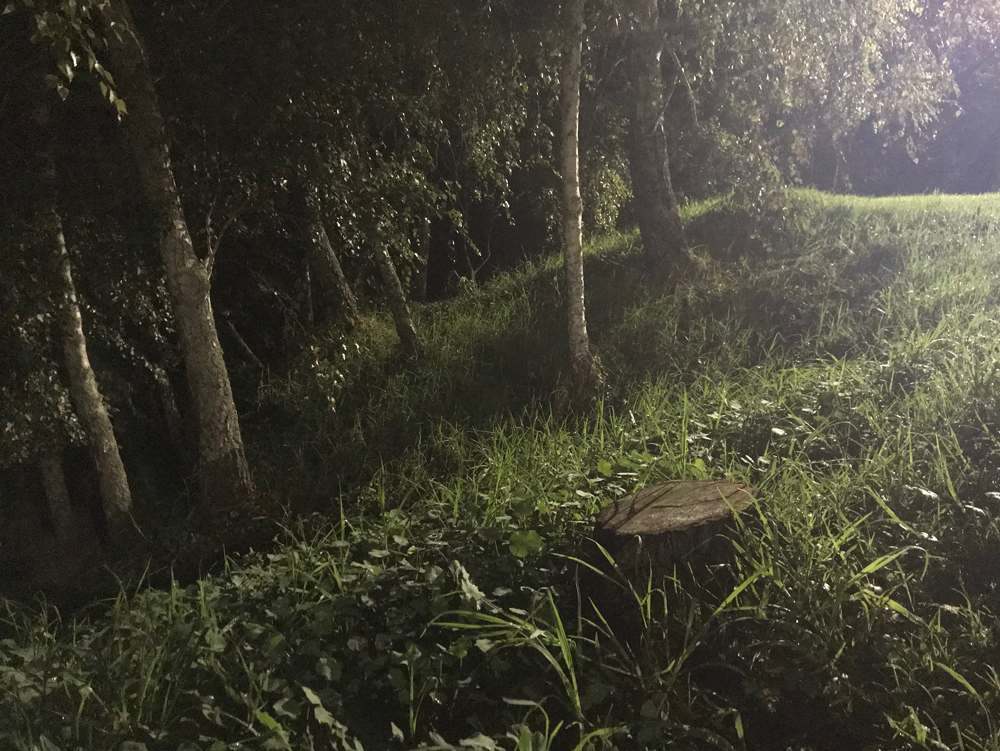
An experimental series of video works I filmed in the dawn hours over Anzac weekend. Each focuses on a tree stump (with other living trees or plants featured somewhere in frame for contrast). Titled “For the Fallen” (after the poem by Laurence Binyon recited at each Anzac commemoration as an ode of remembrance). I spent one minute in silence filming each tree stump. The meditative breath of the witness off camera can be seen in the gentle rise and fall of the framed shot; an honouring of the lost and destroyed. Grey Lynn Park, the site of these videos, has a colonial history all of its own; a continual re-evaluation of its physical worth through a series of expansionist policies: Native bush felled to become a literal wasteland – a Victorian refuse dump. Then, European saplings planted and a gradual gentrification as nearby land prices swelled in value, and a circumvolution as the non-native interlopers are steadily culled and replaced by endemic species. These works were created during Lockdown level 4 and as such there is a natural yet unnatural hush in this urban park, a turning back of time. If exhibited, I envision these pieces in a series, each screen featuring a single tree stump on a 1 minute loop with the volume turned up high so that en masse there is a cacophony of silence; an aural physicality to what is present and what is not. (Dane suggested a trial of viewing the footage sideways or upside-down as it can sometimes throw up a completely different reading.) 

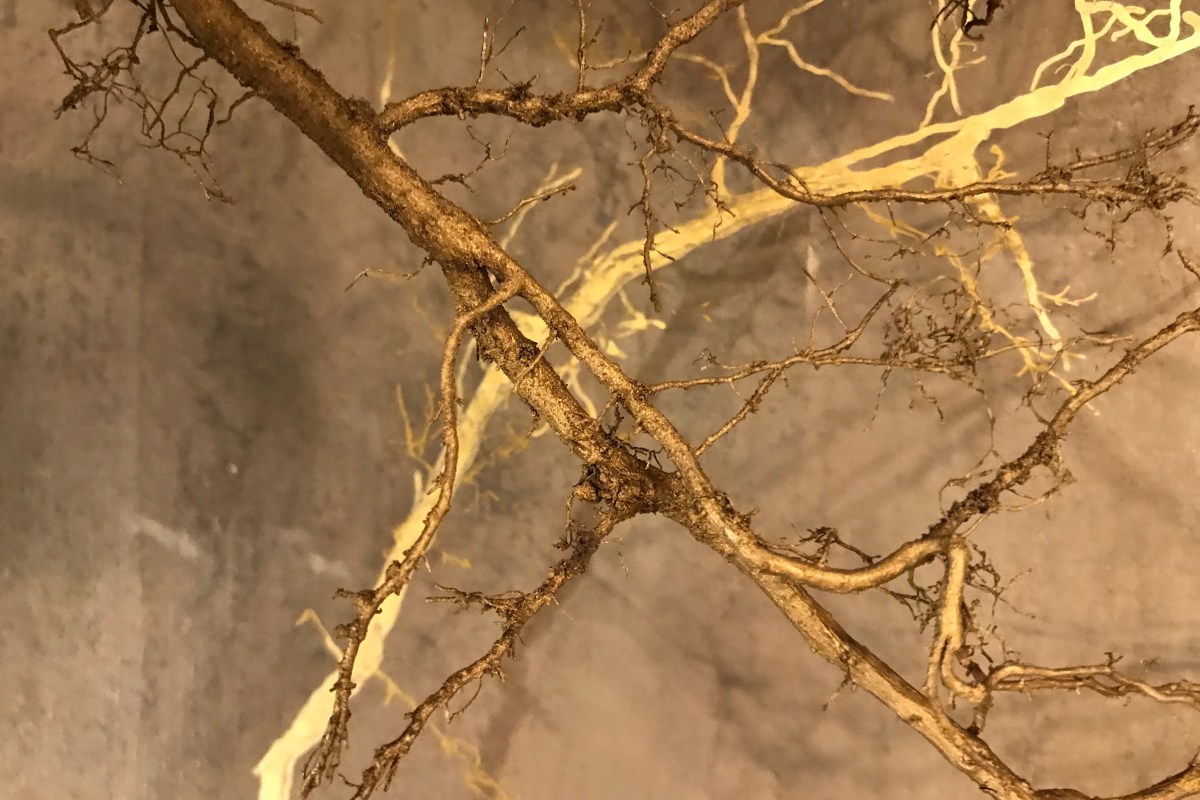
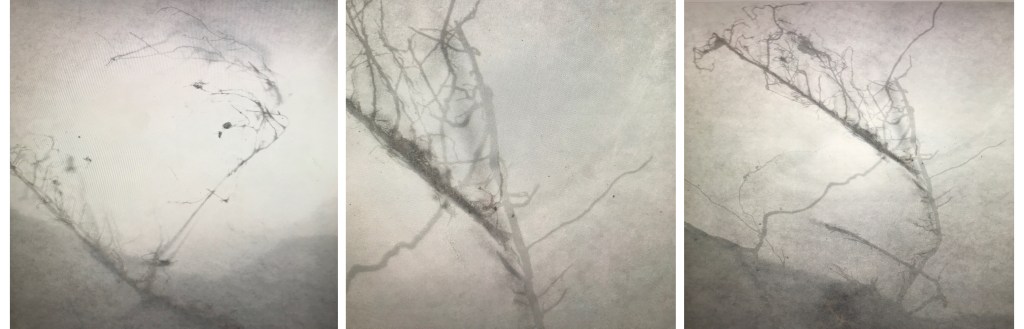
  • Photographs and ethereal scans of composed interlacing root systems. 
Abbie Read, Exploratory root scans, April 2020

I am drawn to the elongated shadows of the intertwined venal entanglements; they too interlace but are flattened by their mono-tonal reflection: all shadows have one tone, one depth. 

Recommended artists to research: 

Robert Smithson – tree works
Matthew Barney – tree works cast in bronze 

Peter Zumthor – and his use of trees in the Bruder Klaus Field Chapel (Germany 2007): A series of vertical cavities within the cast concrete walls of the interior space are the traces left behind by 112 burnt out tree trunks. 

Gallery

Zac Langdon-Pole exhibition

Zac Langdon-Pole Interbeing Michael Lett Gallery 29 Jan – 29 Feb 2020

Notes and personal impressions:

Michaellett.com/exhibition/zaclangdonpole2/

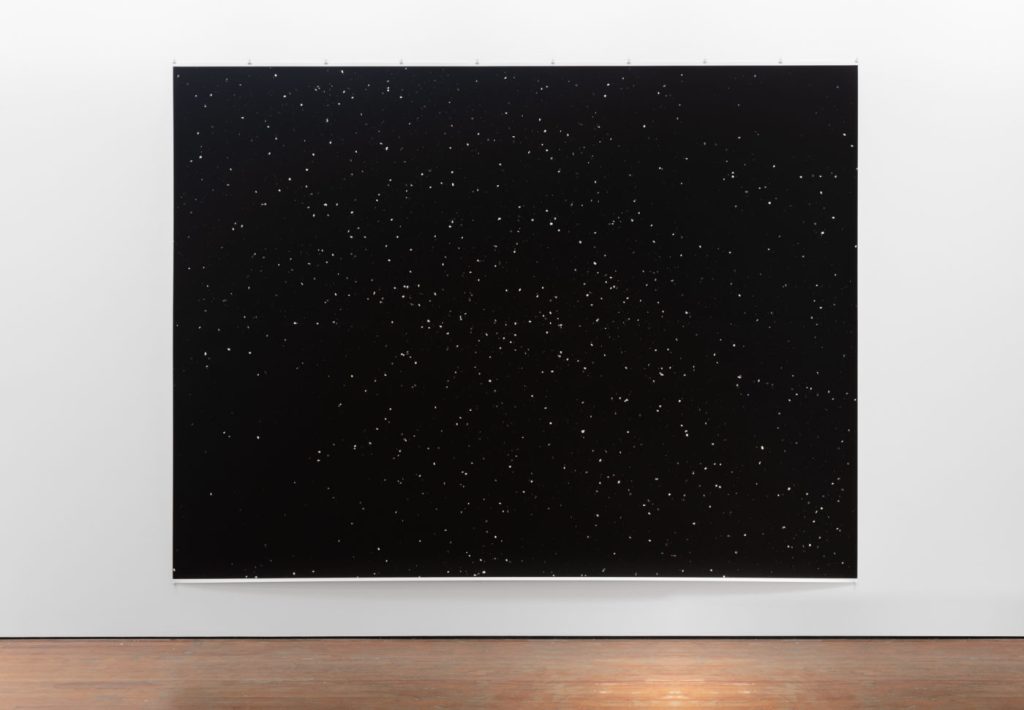
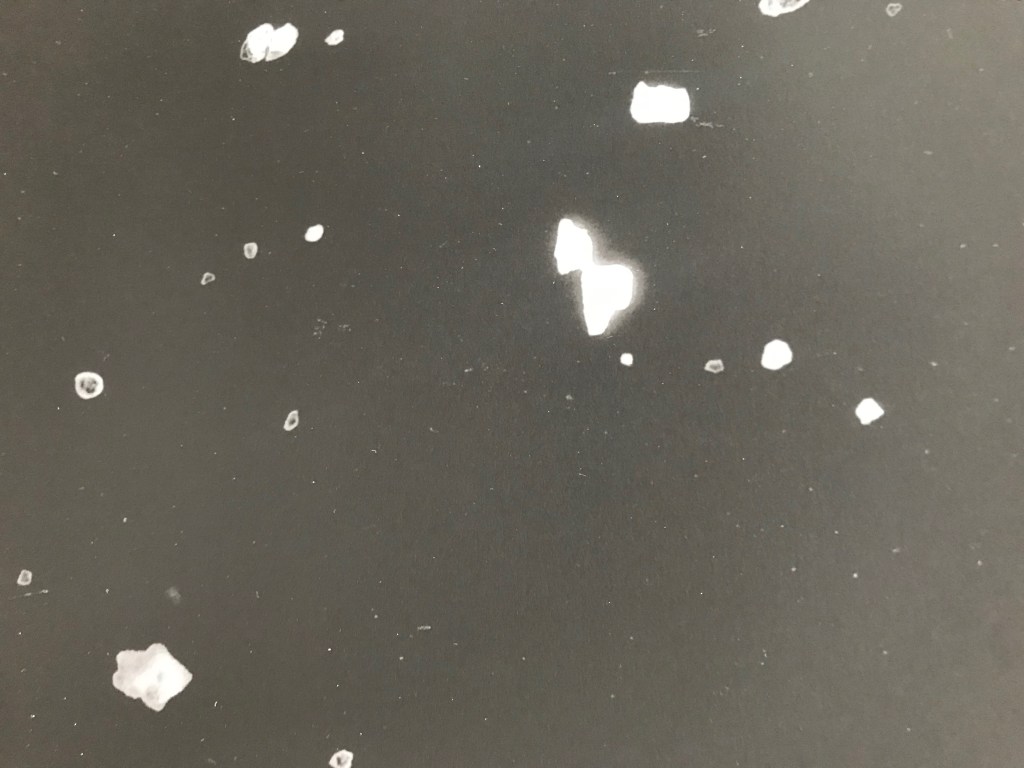
Zac Langdon-Pole, Te Whanganui-A-Hei / Cooks Beach 12.06.2019, 2019, sand photogram (1000% enlarged), made with sand from Te Whananui-A-Hei / Cooks Beach, Aotearoa New Zealand, archival hahnemuhle fineart print, 3012 x3940mm, NZD 42,000

Entering the gallery, attention is immediately drawn to the boundless dark chasm encapsulated in print across the room. Initially this magisterial image appears to be a telescopic documentation of the celestial panoply. A ‘window’ of expansive darkness populated by specks of light, it engulfs and seduces the viewer ever closer. The spectator becomes participant. 

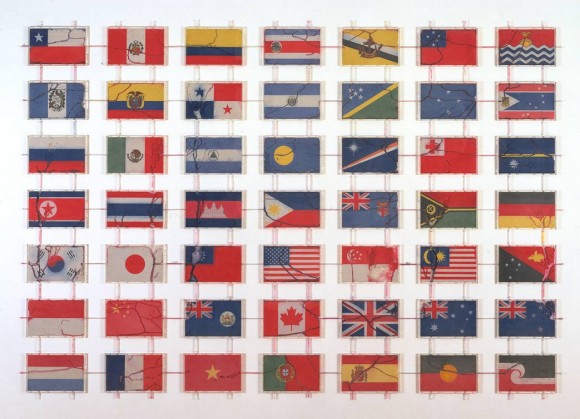
This aspect reminded me of a formative encounter with Yukinori Yanagi’s World Flag Ant Farm (1990), many years ago.


Yukinori Yanagi, Pacific. [Mixed Media. 282 x 405 x 1.8cm] 1996

The work, and a spectator’s understanding of it, transitions on the walk towards it; the physical and judgemental perspectives shift accordingly with each step forward.

A series of national flags are arranged on a distant wall. Gradually it appears that they are incomplete, crumbling. As the viewer draws nearer still, the flags appear to be shifting or stirring within their perspex frames. A final analysis reveals the presence of a colony of ants, busy creating tunnels through the coloured sand which constitutes each flag. As the ants transit and transfer sand from one flag to the other, they gradually erode the borders between the nations in a micro global migration. In this age of competing and fleeting attention spans, this ‘dance’ of audience and artwork, the enchantment and enticement to closer appraisal, is one I wish to emulate in my own art pieces.


Zac Langdon-Pole, Te Whanganui-A-Hei/Cooks Beach 12.06.2019 [detail], 2019

On closer inspection of Langdon-Pole’s work, the interstitial space is not interstellar. These imposing cosmic depictions are in fact enlarged photograms of sand particles taken from the beach after which each artwork is named. Viewpoint and perception are transported from the literally astronomical to the barely macroscopic. Our Solar System, comprised from fragments of ancient stars, echoes the sand as an ephemeral remnant of assorted scattered particles from other entities; a material measurement of the passage of time.

Our position, as audience, immediately shifts with this scale change: from insignificant and awe-inspired subordinates peering at a distant infinity to metaphorical giants able to trample the semi-crystalline subject matter underfoot; gods of our terrestrial domain. In this and his corresponding works, Langdon-Pole exalts the otherwise insignificant and for a brief moment transforms it from infinitesimal to infinite. 

Other associations may be drawn to Buddhist sand mandalas; temporal renderings of geometric patterns made from coloured crushed stone, which are ultimately ceremonially erased symbolising the acceptance of the transitory nature of the universe. Langdon-Pole discusses, “thinking of a stone not as an object but as a momentary aggregate of sand. I am interested in looking at things as processes rather than in an essentialist way.” (Quoted in  http://moussemagazine.it/zac-langdon-pole-francesco-tenaglia-2020/ by Francesco Tenaglia)

From the Artist’s talk  I learnt that Langdon-Pole’s previous works have included hand carved meteorites encased in fragile nautilus shells (made by squid): one originating from the distant heavens, the other from the oceanic depths; both, in their way, non-terrestrial. The mapping of stars is all about the scale of time. It alludes to the colonial history of our astrally guided collective ancestors voyaging vast oceans, to discover distant lands; and moreover to the Christian missionaries adept at utilising their ability to predict eclipses to help convert the native enclave.

After winning the BMW travel project award, Langdon-Pole followed an equally migratory transit spending two years collecting small samples of sand from different geographic locations. His images are produced by making photograms of the sprinkled sand on light sensitive paper; a very analogue methodology.

The sand itself is of a particular time, as well as place. As time passes, the constitutional makeup of the particles will differ considerably. Therefore, the titles of the works include a date alongside the location of the place they were collected. An archive of a particular point in time and physical space; an earthly mapping. He speaks of the work being about time, space and matter; both celestial space and the pictorial space between the grains of sand.

I am reminded of the techniques employed by Film and TV directors in the time before the now ubiquitous CGI. Twinkling night skies were produced by fading between images of sprinkled salt grains (sugar crystals being too square), over a large, flat, black cardboard background.

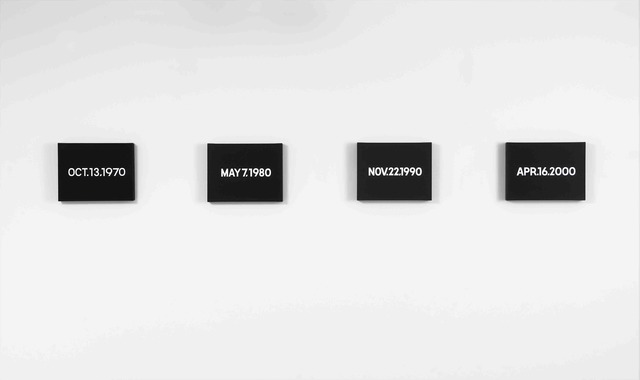
Langdon-Pole talks of the influence of Japanese conceptual artist, On Kawara’s ‘Date paintings’. 


On Kawara, Four Decades (Oct.13, 1970 / May 7, 1980 / Nov. 22,1990 / Apr. 16, 2000), [Liquitex on canvas in handmade cardboard box with newspaper clippings], 1970, 1980, 1990, 2000

On Kawara’s ‘Today series’, was made over the course of forty or so years, from 1966 onwards. Each canvas displaying one simple line of acrylic text of the day’s date; a frozen moment in time; a still-life of sorts, but one in which in which the memories and associations invoked are not pre-ascribed, as each piece is interpreted anew by each new viewer.


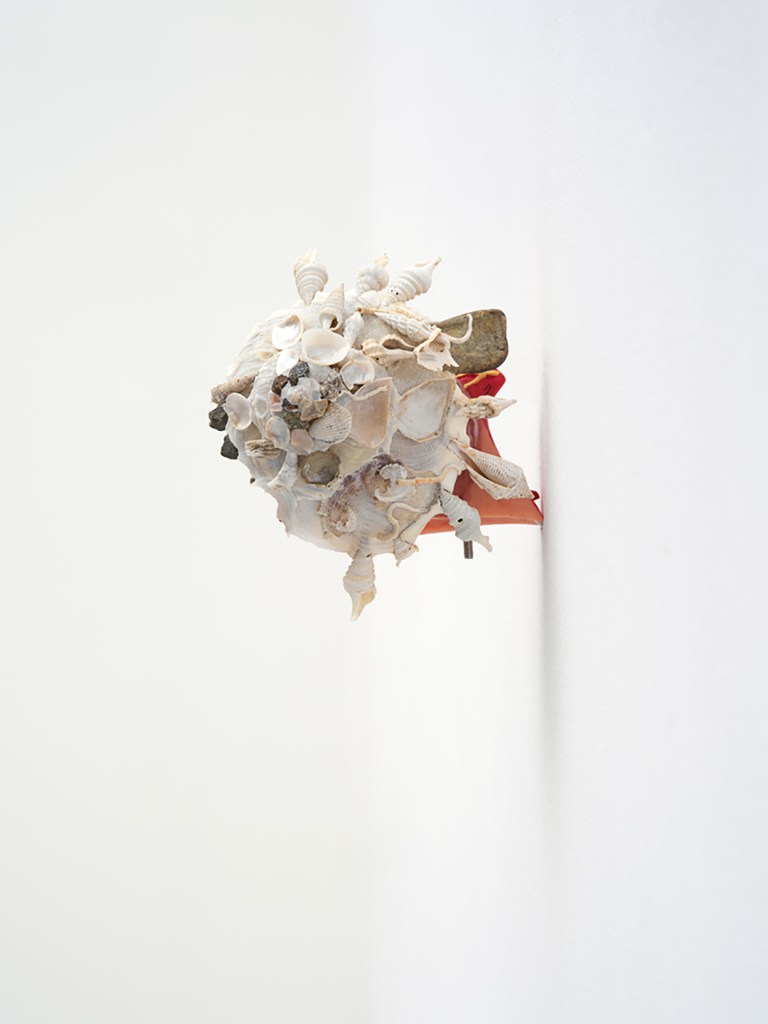
Zac Langdon-Pole, Cleave Study (ii), 2019

Other pieces in this exhibition:

Langdon-Pole gathers together seemingly disparate objects in a curated assemblage in which each object or juxtaposition of objects informs the reading of the entirety. Much like the Xenophora marine gastropod itself, as seen in Cleave Study (ii), which collects stray flotsam to attach to its own shell, becoming its own depository and assemblage art object.

The verb ‘to cleave’ has the unique distinction of having two wholly antithetical meanings: to cling together or to divide apart. This linguistic oddity is hinted at within the artwork by its pairing with a (plasticised) human tongue, which usurps the body of the fleshy sea snail. In alluding to language, the tongue highlights its own presence as a foreigner in the scenario: it is not a native speaker to that which is from a sub-marine domain.

Other works are comprised of artificial medical cross sections of seemingly osseous matter coupled with resin orbs with inert organic inclusions such as seeded dandelion heads. These ephemeral dandelion ‘clocks’ are reminiscent of the childlike games of telling time, as one puff send the seeds on their own migratory space journey.

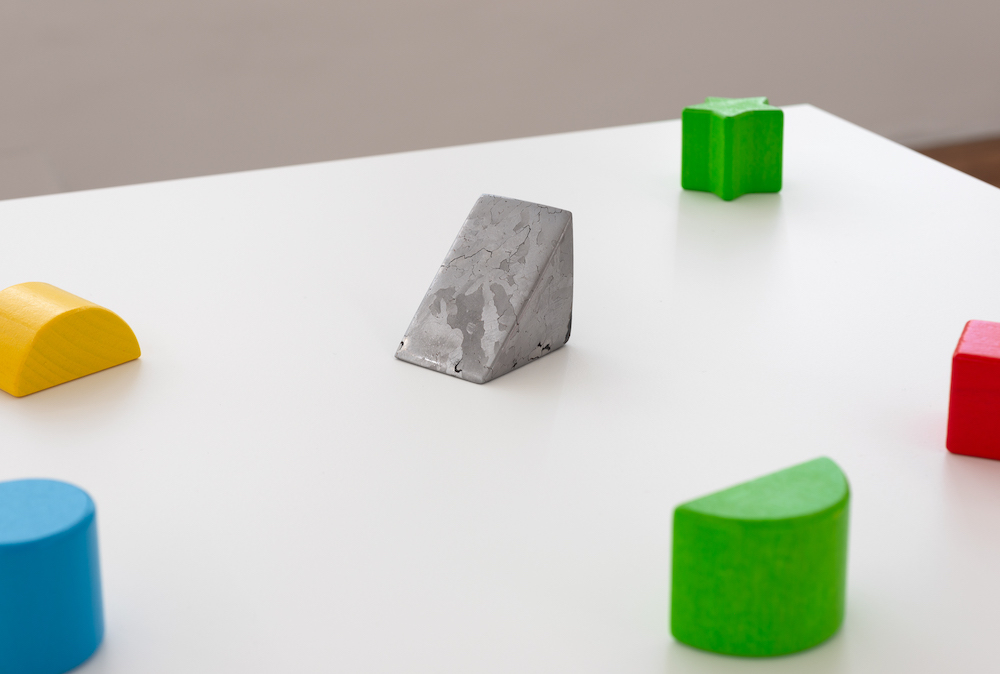
Upstairs, in a traditional glass display case is a piece titled Assimilation study


Zac Langdon-Pole, Assimilation Study (detail), [Painted wooden shape-sorter 
blocks, hand carved Campo del Cielo meteorite, artist designed display case, acrylic,  
MDF, paint], 2020

Upon viewing, it is immediately apparent that one of the component pieces is an interloper. The shape-sorting toy represents a first, infantile encounter with the physical world; primary coloured, basic volumetric shapes formed from prosaic wood and paint. In contrast, the singular imposter: an artificially manipulated authentic meteorite, is far from commonplace; its apparent mundanity belying its exceptional ‘otherness’ as a non-terrestrial object out of place.

This piece speaks to me of taxonomy and classification, of the intensely humanistic need to categorise, label and ‘sort’ all matter by colour, shape, material or other defining aesthetics; the action of which, designates either an intrinsic inclusion or exclusion of a certain object. This artwork, like the other works in this show, speaks of foreignness and of other-worldly migrations.

Just as sand is used in an hourglass to measure the passing of time, Meteorites are their own cosmic time capsules, encasing grains of stardust older than Earth itself. When we look at the night sky, we are looking at history, not just a distant memory of the past but a record of how the heavens looked hundreds of years ago. This exhibition reminds us to comprehend that we, on this planet, are minute particles in an infinite universe; a universe where ‘otherness’, as we might perceive it, is vastly more limitless and significant than humankind.

References:

Tulia Thompson, My God, It’s Full of Stars! Two Auckland art shows on bodies colliding with space, The Spinoff, 29 February 2020, https://thespinoff.co.nz/art/29-02-2020/my-god-its-full-of-stars-two-auckland-art-shows-on-bodies-colliding-with-space/

John Hurrell, Langdon-Pole’s Celestial Avian Guides, Eye Contact, 7 Feb 2020, http://eyecontactsite.com/2020/02/langdon-poles-celestial-avian-guides

Francesco Tenaglia, Beneath Those Stars: Zac Langdon-Pole, Mousse Magazine, http://moussemagazine.it/zac-langdon-pole-francesco-tenaglia-2020/ 

Amanda Renshaw, Heaven & Earth: unseen by the naked eye, London: Phaidon Press Ltd, 2002.