Zac Langdon-Pole Interbeing Michael Lett Gallery 29 Jan – 29 Feb 2020
Notes and personal impressions:
Michaellett.com/exhibition/zac–langdon–pole–2/
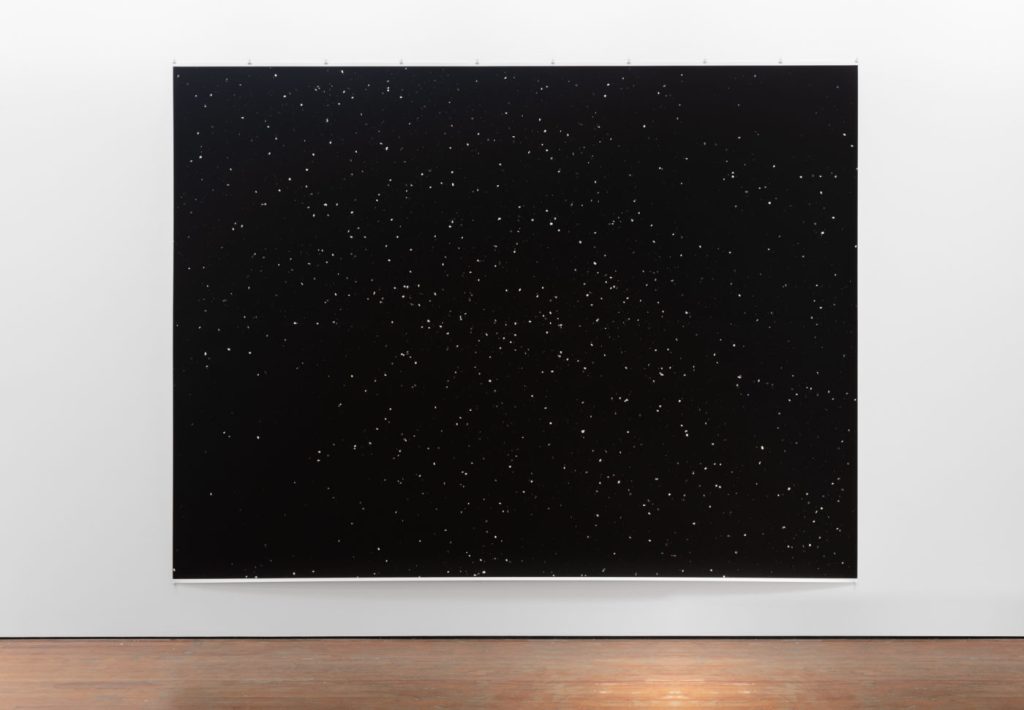
Entering the gallery, attention is immediately drawn to the boundless dark chasm encapsulated in print across the room. Initially this magisterial image appears to be a telescopic documentation of the celestial panoply. A ‘window’ of expansive darkness populated by specks of light, it engulfs and seduces the viewer ever closer. The spectator becomes participant.
This aspect reminded me of a formative encounter with Yukinori Yanagi’s World Flag Ant Farm (1990), many years ago.
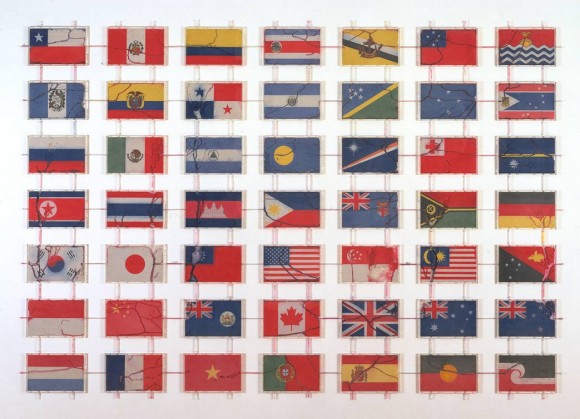
Yukinori Yanagi, Pacific. [Mixed Media. 282 x 405 x 1.8cm] 1996
The work, and a spectator’s understanding of it, transitions on the walk towards it; the physical and judgemental perspectives shift accordingly with each step forward.
A series of national flags are arranged on a distant wall. Gradually it appears that they are incomplete, crumbling. As the viewer draws nearer still, the flags appear to be shifting or stirring within their perspex frames. A final analysis reveals the presence of a colony of ants, busy creating tunnels through the coloured sand which constitutes each flag. As the ants transit and transfer sand from one flag to the other, they gradually erode the borders between the nations in a micro global migration. In this age of competing and fleeting attention spans, this ‘dance’ of audience and artwork, the enchantment and enticement to closer appraisal, is one I wish to emulate in my own art pieces.
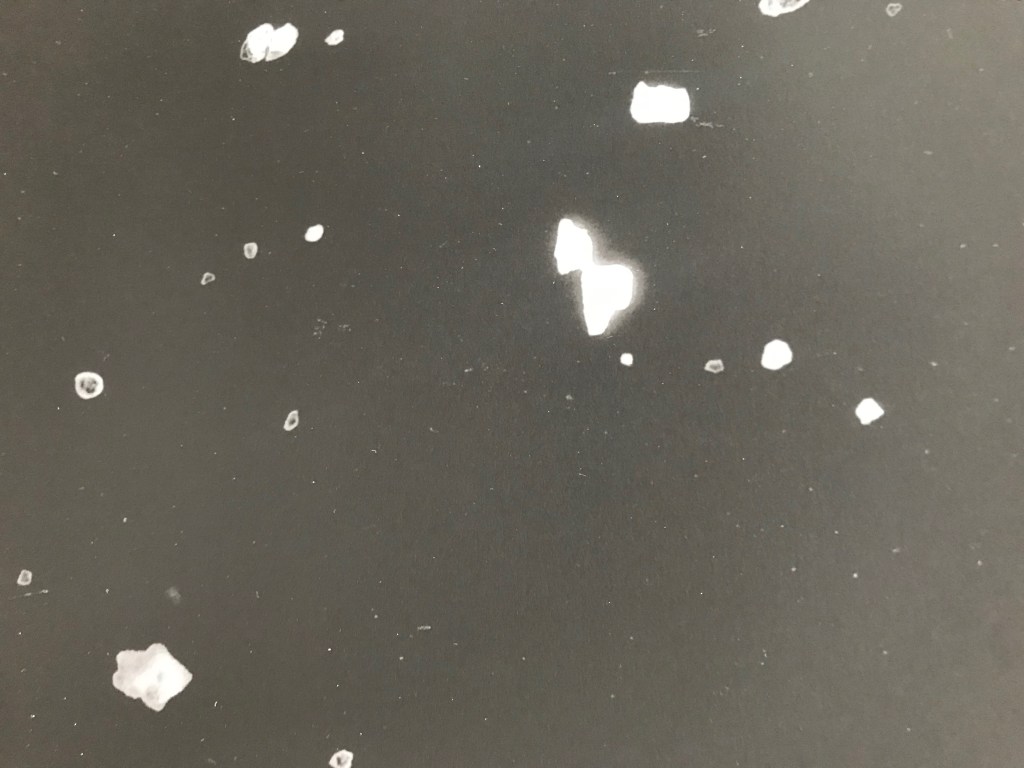
Zac Langdon-Pole, Te Whanganui-A-Hei/Cooks Beach 12.06.2019 [detail], 2019
On closer inspection of Langdon-Pole’s work, the interstitial space is not interstellar. These imposing cosmic depictions are in fact enlarged photograms of sand particles taken from the beach after which each artwork is named. Viewpoint and perception are transported from the literally astronomical to the barely macroscopic. Our Solar System, comprised from fragments of ancient stars, echoes the sand as an ephemeral remnant of assorted scattered particles from other entities; a material measurement of the passage of time.
Our position, as audience, immediately shifts with this scale change: from insignificant and awe-inspired subordinates peering at a distant infinity to metaphorical giants able to trample the semi-crystalline subject matter underfoot; gods of our terrestrial domain. In this and his corresponding works, Langdon-Pole exalts the otherwise insignificant and for a brief moment transforms it from infinitesimal to infinite.
Other associations may be drawn to Buddhist sand mandalas; temporal renderings of geometric patterns made from coloured crushed stone, which are ultimately ceremonially erased symbolising the acceptance of the transitory nature of the universe. Langdon-Pole discusses, “thinking of a stone not as an object but as a momentary aggregate of sand. I am interested in looking at things as processes rather than in an essentialist way.” (Quoted in http://moussemagazine.it/zac-langdon-pole-francesco-tenaglia-2020/ by Francesco Tenaglia)
From the Artist’s talk I learnt that Langdon-Pole’s previous works have included hand carved meteorites encased in fragile nautilus shells (made by squid): one originating from the distant heavens, the other from the oceanic depths; both, in their way, non-terrestrial. The mapping of stars is all about the scale of time. It alludes to the colonial history of our astrally guided collective ancestors voyaging vast oceans, to discover distant lands; and moreover to the Christian missionaries adept at utilising their ability to predict eclipses to help convert the native enclave.
After winning the BMW travel project award, Langdon-Pole followed an equally migratory transit spending two years collecting small samples of sand from different geographic locations. His images are produced by making photograms of the sprinkled sand on light sensitive paper; a very analogue methodology.
The sand itself is of a particular time, as well as place. As time passes, the constitutional makeup of the particles will differ considerably. Therefore, the titles of the works include a date alongside the location of the place they were collected. An archive of a particular point in time and physical space; an earthly mapping. He speaks of the work being about time, space and matter; both celestial space and the pictorial space between the grains of sand.
I am reminded of the techniques employed by Film and TV directors in the time before the now ubiquitous CGI. Twinkling night skies were produced by fading between images of sprinkled salt grains (sugar crystals being too square), over a large, flat, black cardboard background.
Langdon-Pole talks of the influence of Japanese conceptual artist, On Kawara’s ‘Date paintings’.
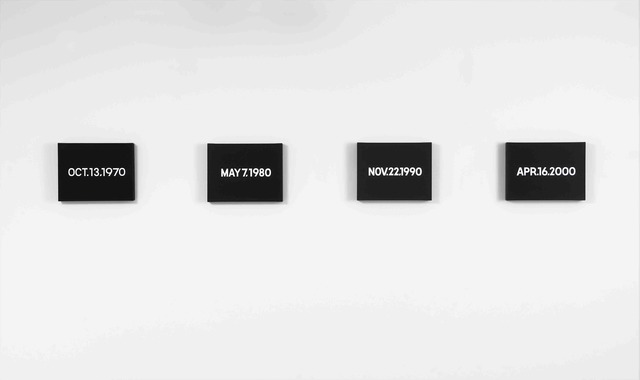
On Kawara, Four Decades (Oct.13, 1970 / May 7, 1980 / Nov. 22,1990 / Apr. 16, 2000), [Liquitex on canvas in handmade cardboard box with newspaper clippings], 1970, 1980, 1990, 2000
On Kawara’s ‘Today series’, was made over the course of forty or so years, from 1966 onwards. Each canvas displaying one simple line of acrylic text of the day’s date; a frozen moment in time; a still-life of sorts, but one in which in which the memories and associations invoked are not pre-ascribed, as each piece is interpreted anew by each new viewer.
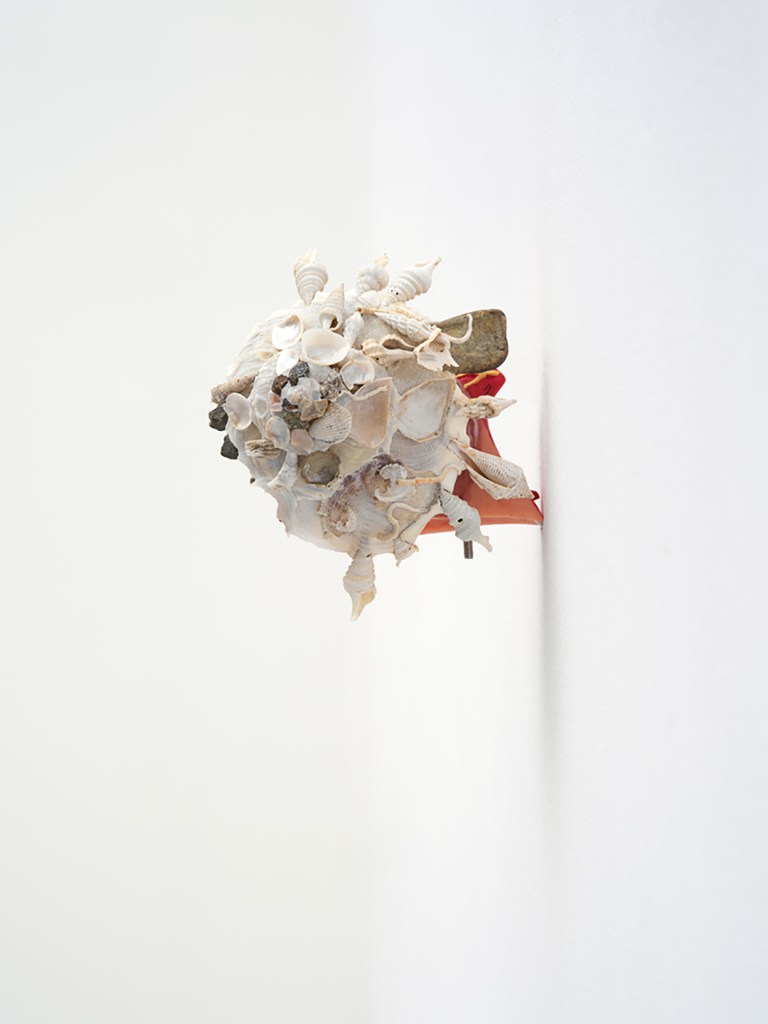
Zac Langdon-Pole, Cleave Study (ii), 2019
Other pieces in this exhibition:
Langdon-Pole gathers together seemingly disparate objects in a curated assemblage in which each object or juxtaposition of objects informs the reading of the entirety. Much like the Xenophora marine gastropod itself, as seen in Cleave Study (ii), which collects stray flotsam to attach to its own shell, becoming its own depository and assemblage art object.
The verb ‘to cleave’ has the unique distinction of having two wholly antithetical meanings: to cling together or to divide apart. This linguistic oddity is hinted at within the artwork by its pairing with a (plasticised) human tongue, which usurps the body of the fleshy sea snail. In alluding to language, the tongue highlights its own presence as a foreigner in the scenario: it is not a native speaker to that which is from a sub-marine domain.
Other works are comprised of artificial medical cross sections of seemingly osseous matter coupled with resin orbs with inert organic inclusions such as seeded dandelion heads. These ephemeral dandelion ‘clocks’ are reminiscent of the childlike games of telling time, as one puff send the seeds on their own migratory space journey.
Upstairs, in a traditional glass display case is a piece titled Assimilation study:
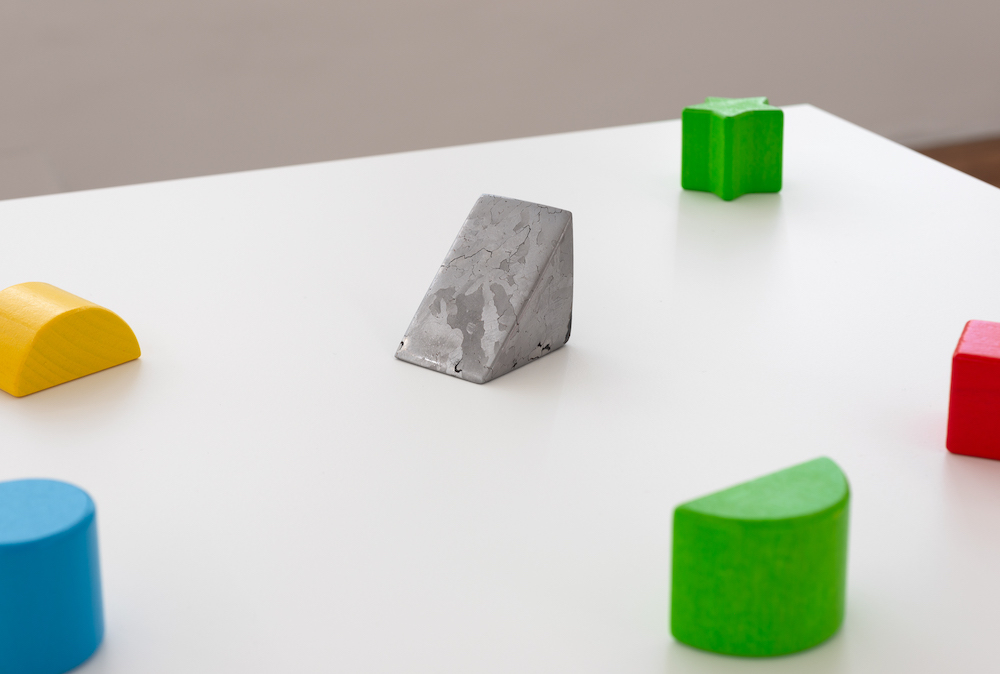
Zac Langdon-Pole, Assimilation Study (detail), [Painted wooden shape-sorter
blocks, hand carved Campo del Cielo meteorite, artist designed display case, acrylic,
MDF, paint], 2020
Upon viewing, it is immediately apparent that one of the component pieces is an interloper. The shape-sorting toy represents a first, infantile encounter with the physical world; primary coloured, basic volumetric shapes formed from prosaic wood and paint. In contrast, the singular imposter: an artificially manipulated authentic meteorite, is far from commonplace; its apparent mundanity belying its exceptional ‘otherness’ as a non-terrestrial object out of place.
This piece speaks to me of taxonomy and classification, of the intensely humanistic need to categorise, label and ‘sort’ all matter by colour, shape, material or other defining aesthetics; the action of which, designates either an intrinsic inclusion or exclusion of a certain object. This artwork, like the other works in this show, speaks of foreignness and of other-worldly migrations.
Just as sand is used in an hourglass to measure the passing of time, Meteorites are their own cosmic time capsules, encasing grains of stardust older than Earth itself. When we look at the night sky, we are looking at history, not just a distant memory of the past but a record of how the heavens looked hundreds of years ago. This exhibition reminds us to comprehend that we, on this planet, are minute particles in an infinite universe; a universe where ‘otherness’, as we might perceive it, is vastly more limitless and significant than humankind.
References:
Tulia Thompson, My God, It’s Full of Stars! Two Auckland art shows on bodies colliding with space, The Spinoff, 29 February 2020, https://thespinoff.co.nz/art/29-02-2020/my-god-its-full-of-stars-two-auckland-art-shows-on-bodies-colliding-with-space/
John Hurrell, Langdon-Pole’s Celestial Avian Guides, Eye Contact, 7 Feb 2020, http://eyecontactsite.com/2020/02/langdon-poles-celestial-avian-guides
Francesco Tenaglia, Beneath Those Stars: Zac Langdon-Pole, Mousse Magazine, http://moussemagazine.it/zac-langdon-pole-francesco-tenaglia-2020/
Amanda Renshaw, Heaven & Earth: unseen by the naked eye, London: Phaidon Press Ltd, 2002.
 Abbie Read