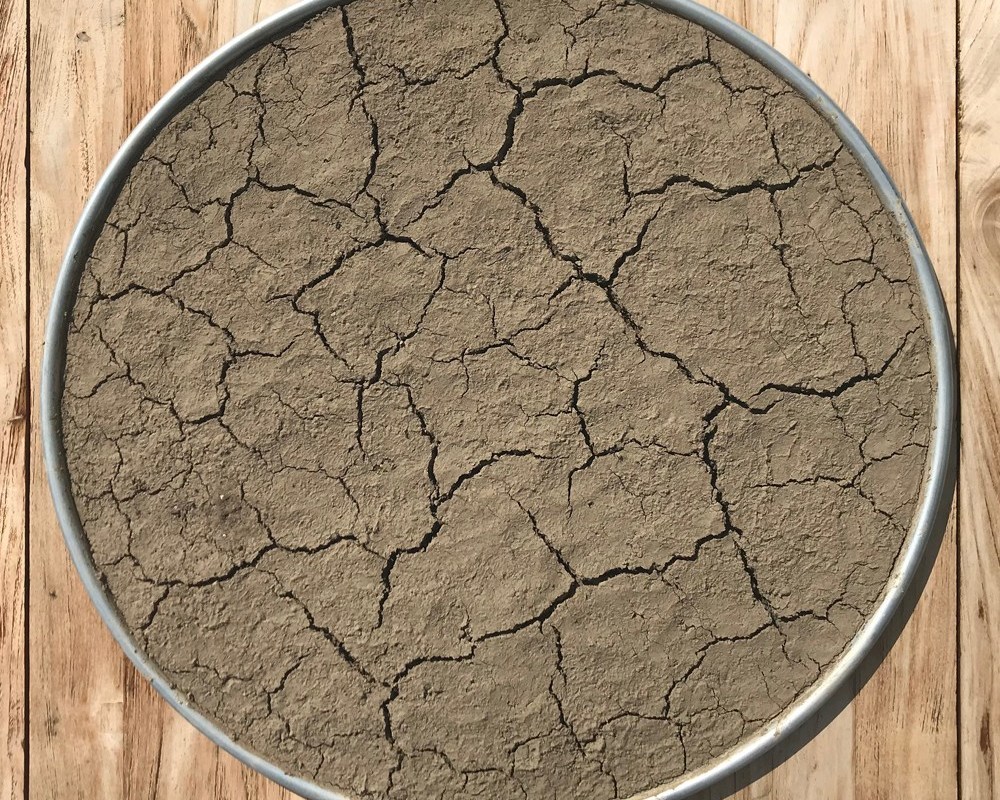
Abbie Read, Work in progress: mud disc I, April 2020.
Oft unnoticed or dismissed, I am endlessly entranced by the slight or negligible; objects seldom considered of value or beauty; items seldom considered as objects at all.
I work with mostly natural materials: wood, earth, clay, mould and bacteria, utilising their materiality and innate associations to explore notions of contextual value and of life, still life and the absence thereof.
At present, I am contemplating generative and degenerative systems, both natural and enforced, and their inter-relational entwinings. My predilection lies towards Negentropy; a fascination for the natural processes of decay, interwoven with a desire to analyse and preserve. In so doing I inevitably order the chaotic, and perversely halt the living, mutable entity which first enticed me, in order to capture and immortalise its essence.
I am an observer, a collector and assembler; Artist as witness, compiler and instigator. I am interested in the practice and politics of display and the necessarily judgemental protocols which expressly determine what gets preserved or exhibited and how.
I enjoy the physicality of ideas made manifest; an embodied entanglement of symbiotic concepts and considerations. I am also drawn to what is not embodied; the interstitial space, the silence, the absences.
The aesthetics of my practice align with much of what is understood as the philosophy of Wabi-Sabi; a subtly intangible Japanese ideology which finds value in the simplicity of natural imperfections. It speaks to the delicate traces of impermanence and expounds that “the closer things get to nonexistence, the more exquisite and evocative they become.” (Koren, Wabi-Sabi for Artists, Designers, Poets & Philosophers, 50.)
This viewpoint is shared by the Victorian art critic John Ruskin who also observes a certain sublimity in the monotonous or mundane and exclaims that “to banish imperfection is to destroy expression, to check exertion, to paralyse vitality. All things are literally better, lovelier, and more beloved for the imperfections which have been divinely appointed.” (Ruskin, On Art and Life, 27.)
I have been looking at the works of land artists such as Andy Goldsworthy, in particular his works with earth and clay. These pieces often acknowledge time and change as being connected to place. He asserts that “the challenge has been not simply to wait for things to decay, but to make change an integral part of a work’s purpose so that, if anything, it becomes stronger and more complete as it falls apart and disappears.” (Goldsworthy, Time, 7.)
The artworks of Pauline Rhodes and Charlotte Prodger also recurrently relate to the passage of time, within a specific environmental context alongside temporal traces of particular events and encounters.
Currently I am being more experimental in how I approach my art making, letting the materials speak and breathe in lieu of being prematurely and prescriptively tied to particular imposed meanings and interpretations. I am learning to bathe in the liminal, not race to encase the finite. Though this I find, is a delicate balance as it is always the coalescing of the myriad flickering ideas that sparks my joy in the creative process.
References:
Leonard Koren. Wabi-Sabi for Artists, Designers, Poets & Philosophers. Berkeley: Stone Bridge Press, 1994.
John Ruskin, On Art and Life. London: Penguin Books, 2004.
Andy Goldsworthy, Time. London: Thames and Hudson, 2000.
Christina Barton, Ground/Work: The Art of Pauline Rhodes. Wellington: Adam Art Gallery & Victoria University Press, 2002.
Tateshots, Charlotte Prodger: Turner Prize Winner 2018: Tate Shots, https://www.youtube.com/watch?v=AsVWk5DlbCE
 Abbie Read