John Reynolds and Jin Jiangbo Performative Geographies
14 July – 8 August 2020, Starkwhite, Auckland
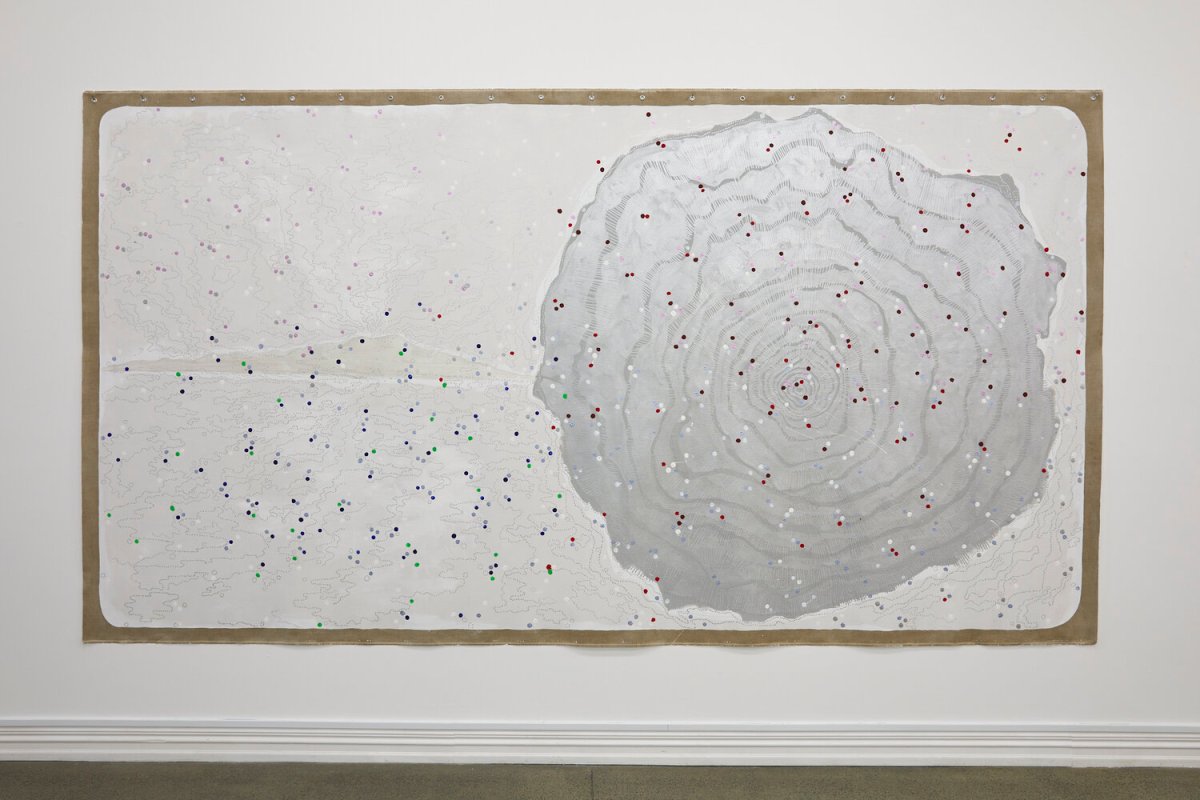
With a particular focus on John Reynolds, Fire and Ash, 2019.


Performative Geographies at theStarkwhite gallery features the artworks of New Zealand artist John Reynolds and Chinese artist Jin Jiangbo, arranged in a literal East/West divide. These thematically conjoined representations of islands, both terrestrial and semi-mythological, explore notions of ‘islandness’, [1] and the mutability of meaning contained within that word.
Jiangbo’s works exude a quiet opulence. They are precise and compact; colourful, ethereal ink renderings on a circular gold background, where depictions of landmarks exhibit less solidity than the (Hanzi) Chinese characters printed nearby.
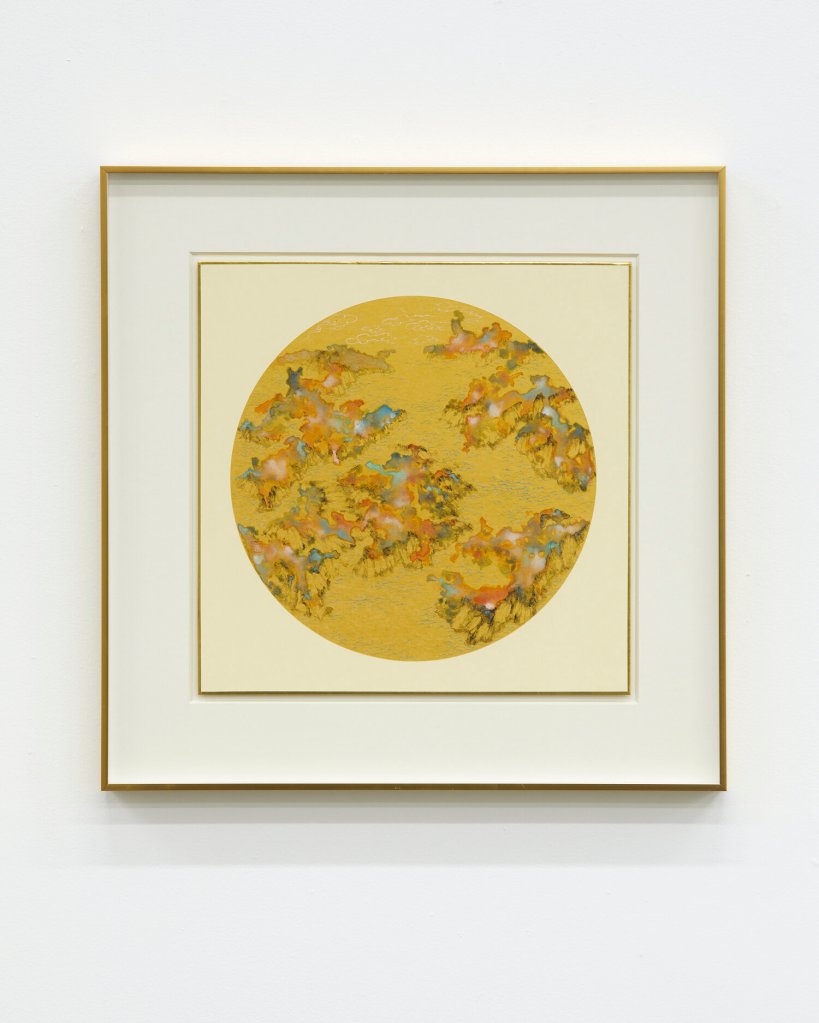
The delicate gilt circles of Jiangbo’s sacred and mystical Chinese landscapes both echo and contrast with the glistening silver of Reynolds’ more organic-shaped imposing volcanic cone, as they complement each other from across the room. Both artists using localised mythology as a generative impetus.
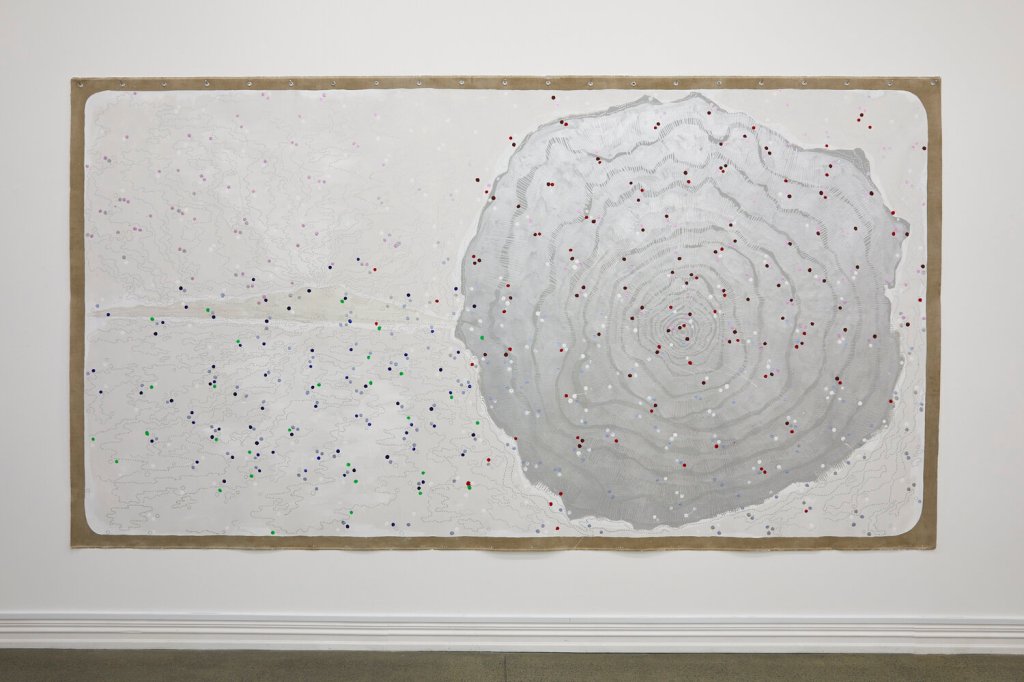
Reynolds’ work often alludes to literature, languaging (both written and pictoral), architectural structures, and site-specifity. In this instance, the title ‘Fire and Ash’ and its subject matter arose from a Sarah Treadwell essay about Austrian geologist Ferninand von Hochstetter’s 1859 map surveying the Auckland volcanic region.[2] In Reynolds’ copy of this essay, the pencilled notations in the margin highlight connotations which resonate with him, and show their influence on his choice of mark-making: Treadwell describes the landscape as “shimmering with dots of volcanic activity” [p.27] and “flying over the perforated and permeable city…weaving between the cones.” [p.28] These ‘perforations’ become ideally characterised by Reynolds’ signature diagrammatic motif of dots and dashes.
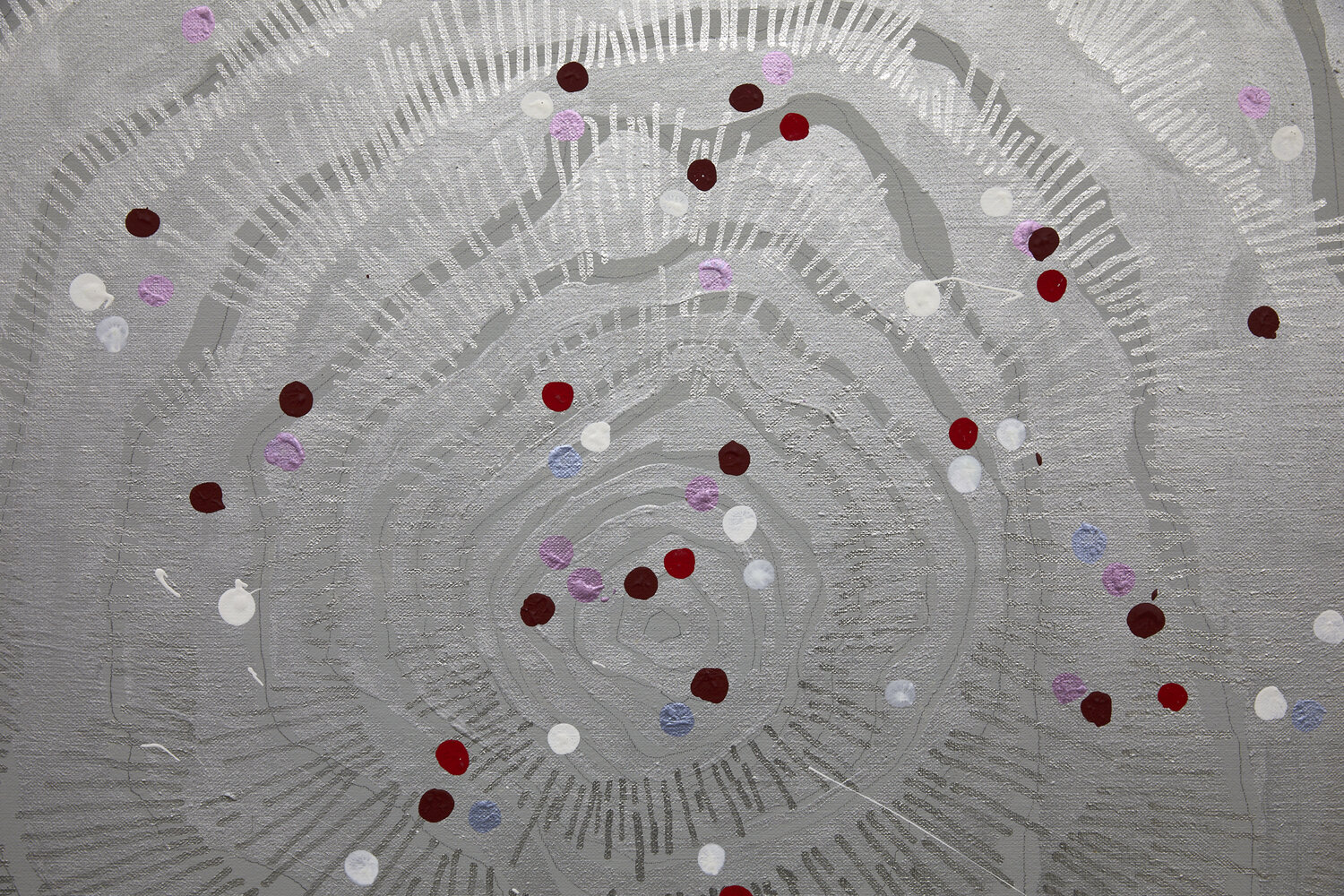
A seemingly amorphous iridescent silver form of irregular concentric undulations occupies much of the right hand side of the large Belgian linen canvas. Ray-like striations in metallic marker emanate from the centre. (Later these will be understood as the contours of terraced terrain.) A familiar semi-transparent silhouette in the background reveals itself as Rangitoto, at which point the striking silver shape becomes discernible as the same; a simultaneous plan and elevation of the picture-postcard Auckland landmark. “Which is about as figurative as I get”, quips Reynolds at his floor talk. [3] “If I burden the artwork with too much figuration, it loses some metaphoric undertone.”
The white-washed background carries intersecting stippled swirls, that meander and eddy as if in currents of wind or water. These playful trails and traces are interspersed by clusters of coloured dots: blues and greens proliferate over the horizon line where sky would meet sea, and more dusky reds and lustrous pinks over the apex of the volcano. On the one side, the rhythm and repetition of the lines free-flowing, and above the petrified lava cone more structured and static; emphasising the stoic perceived permanence of this venerable mountain.

The slight tilt on the horizon line hints at a subterranean instability and lends a certain tension to the piece. This minor shift, possibly not borne of conscious intent, is nevertheless accepted as a relevant reminder of the underlying precarity of living in a volcanic zone; A terra firma not so firm; a portent of impermanence perhaps. Hochstetter’s map evidences the turbulent histories that has seen Auckland’s landscape ravaged by both lava fields and urban domestication. As the viewer’s eye navigates across the peaceable pale leylines of the canvas, the threat and fiery force of potential destruction is, in this moment, calm. The apparent disparity between the geometrical order of urban life and the geological knowledge of the chaotic power that may one day be unleashed is buried here, for today the mountain sleeps. It is perhaps this chaotic aspect that Reynolds is drawn to. His preference for using spray paint and oil sticks due, in part, to those mediums having “just the right amount of lack of control”. [4] Provisionality is a consistent theme within much of Reynolds’ work. His use of certain symbols, his signpost drawings for example, seem almost to be placeholders, not fully present or permanent, awaiting supplantation. So too Rangitoto.
There is a claiming, an implied ownership in cartographical classification. To map a place privileges certain subsets of information. It tells the subjective story of a place and of a time. If a map is, in essence, the illustrative dissemination of a set of selective data, then this too might be considered a map; the legend of which is locked away, as we are asked to bring our own set of perceived associations. This artwork lies within an intersection of painting and drawing, with an emphasis on mark making over definite figuration. Colour, pattern and line are utilised to delineate spatial boundaries and indicate inherent interdependencies.
Reynolds often explores the concept of time as artistic medium. From the sixty-second paintings for the Vacancy exhibition, Te Tuhi (2004), to Snow Tussock and Golden Spaniard (2007/2008), dubbed ‘the slowest artworks in New Zealand’, [5] which will only find their fullest expression in successive decades. Here, Reynolds questions the notion of stasis; a literal still life, or more accurately, a potentially explosive and destructive, currently dormant life force in its temporal docile state. Much like his outdoor art works, this is a topological conversation, a contemplation of shared histories of natural and manmade interventions in the landscape.
A timely and pertinent exhibition: in the midst of a global pandemic, there is currency in the term ‘isolation’; a word with the same etymological origin (insula – Latin) as the word ‘island’, meaning ‘standing detached from others of its kind.’ [6] A fact not lost, I am sure, on an artist noted for his adept appliance of languaging.
References:
[1] Laurence Simmons, Performative Geographies, Stark White Gallery: https://www.starkwhite.co.nz/exhibitions#/performative-geographies-1/
[2] Sarah Treadwell, “Hochstetter’s Map: Flight over Auckland”, in Kei konei koe/you are here: Mapping Auckland, ed. Kathy Waghorn (Auckland: Auckland War Memorial Museum, 2011).
[3] John Reynolds floortalk, Starkwhite Gallery, 18th July 2020
[4] Shirley Horrocks (Director), Questions for Mr Reynolds, 2007: https://www.nzonscreen.com/title/questions-for-mr-reynolds-2007/overview
[5] Roger Horrocks, “John Reynolds Painting, Planting and Performance”, Art New Zealand, Issue 122 (Autumn 2007): https://www.art-newzealand.com/Issue122/reynolds.htm
[6] Online etymology dictionary, accessed 1 August 2020 https://www.etymonline.com/word/isolated
 Abbie Read