
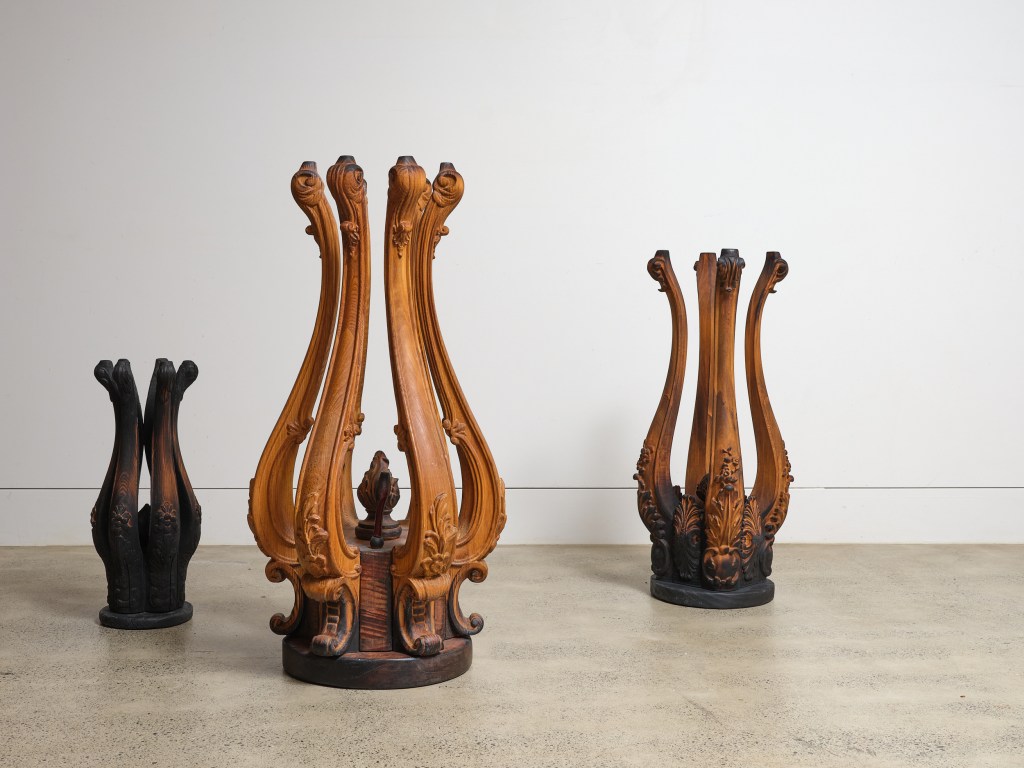
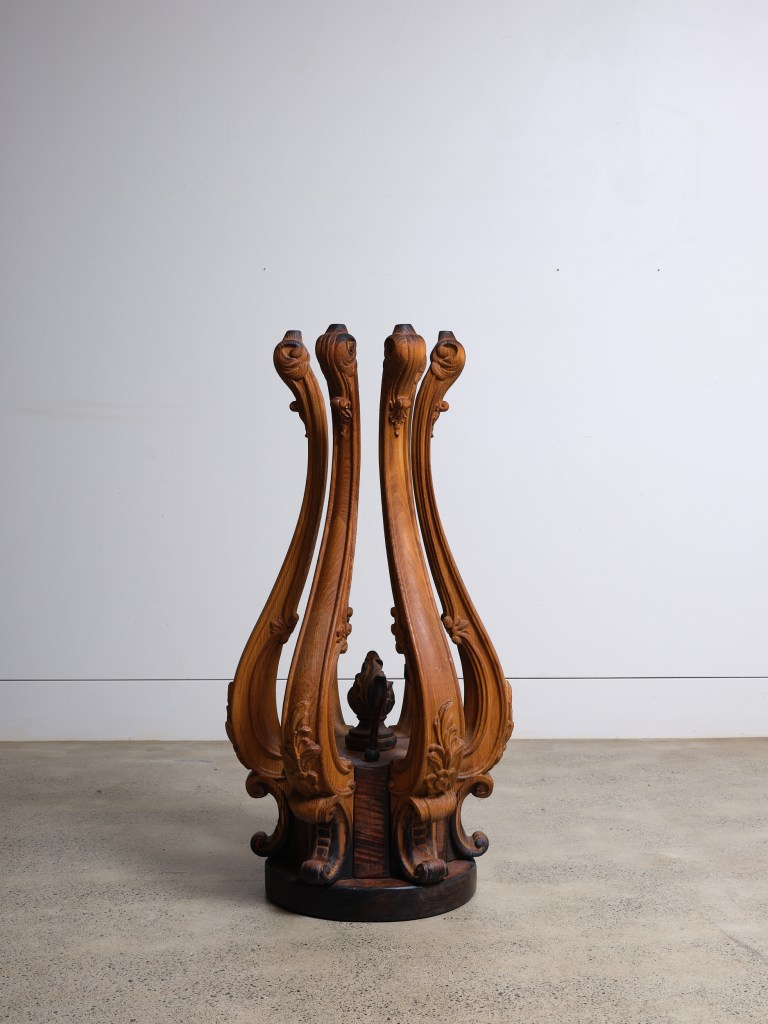
Colonial furniture parts:
cabriole leg ‘petals’ (ash, Ukraine),
finial ‘stigma’ (beechwood, Russia),
table leg ‘stamen’ (mahogany, Europe),
central ‘carpel’ (radiata, New Zealand)
This botanical artifice, these alien still-life forms; readymades remade.
Non-native timbers transported, transplanted; grafted together, forming new hybrid species.
The titling of my work Plantstandplant (2021) is a reference to Simon Starling’s work, Shedboatshed. It alludes to the fact that the artefacts presented are both inverted plant stands and hybrid floral forms. Each orientation presents an object for and of display. A plant operates as an ornamentation device. A plant stand is one ornamental device displaying another. These non-native timbers have been transported, transplanted and grafted together forming new hybrid species: readymades remade. Fabricated from imported timber, a naturally occurring botanical resource has been forged into a stylised semblance of other botanical forms.
In steering towards a collective uniformity, there is an inevitable and irrevocable loss of the endemic, the unique. Traits and traditions are intermingled, co-opted, absorbed, hybridised; a social collage, an acculturated sum comprised of many parts. The resultant entity, in time, naturalises; becomes a new baseline, a new distinct culture of its own.
The process of charring creates a further homogenisation; a blurring of the differentiation between timbers and of geographical or cultural origins. It references the histories of landscape, of wood, of furniture. It implicates the obliteration of the old and the overwriting with the new; the cyclical exchange and transposition of any one culture by another; the transformations that take place within the land, within species, within communities.
 Abbie Read