
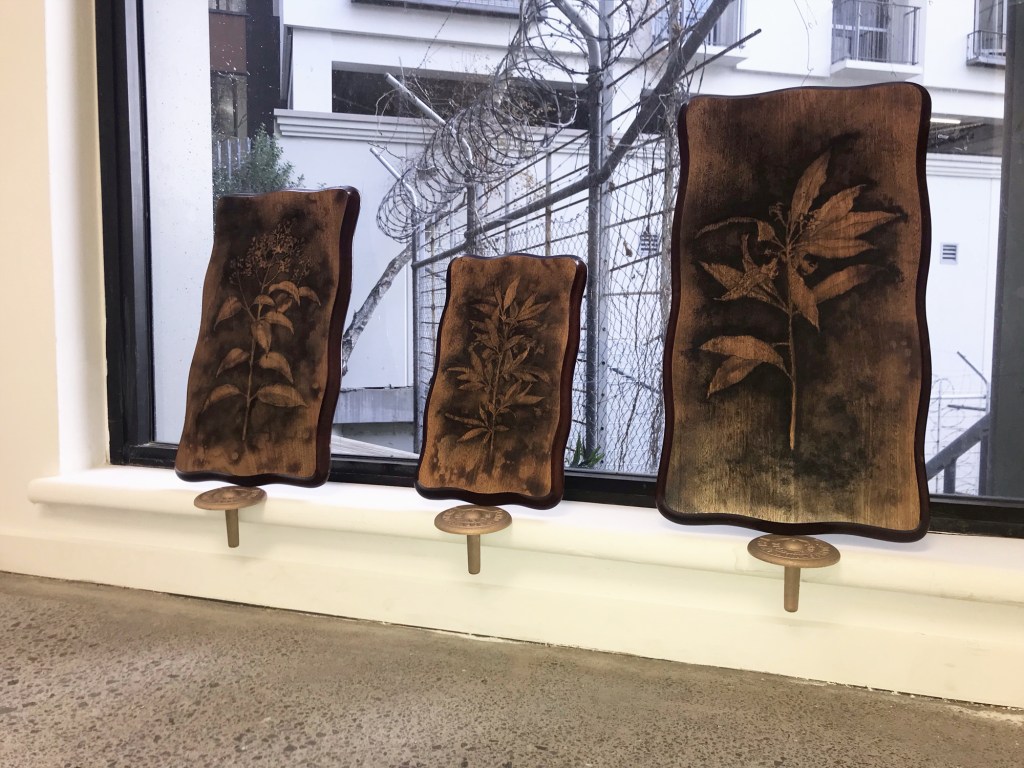
Abbie Read Non-native Tableau 2022
Disassembled colonial furniture (non-native wooden table-tops), furniture wax, smoke, ash,
(non-native) willow and (native) totara charcoal, Land Information N.Z. Survey markers.
.
Artworks:
- Ligustrum lucid – tree privet
“Forms a dense carpet of seedlings on the forest floor, and grows through the understory to dominate and replace canopy trees in most forest types”
Legal Status: Unwanted Organism – DOC
NZ Status: Established [https://www.mpi.govt.nz/biosecurity]
.
2. Salix Fragilis – crack willow
“Replaces native species in wetlands, and forms vast dense stands and thickets. It causes blockages, flooding and structural changes in waterways.”
Legal Status: Unwanted Organism – DOC
NZ Status: Established [https://www.mpi.govt.nz/biosecurity]
.
3. Pittosporum undulatum – sweet pittosporum
“Invades native forest areas and shades out native plants. Its leaves contain toxins that can inhibit the growth of other plants.”
Legal Status: Unwanted Organism – DOC
NZ Status: Established [https://www.mpi.govt.nz/biosecurity]
.
A still life: The ever changing terrain of the New Zealand landscape, host to these and other unsolicited migrations.
Within the practice of taxonomy there is a claiming, an implied ownership. Disassembled botanical drawings, by several uncredited original authors, have here been collated and re-rendered, to comprise an idealised hybrid plant form of its genus; not a portrait of a singular specimen but more a universal archetype. In this action there is an acknowledged borrowing; an assembled collage, reproductions of reproductions, where the definitive lines of authorship are blurred.
 Abbie Read