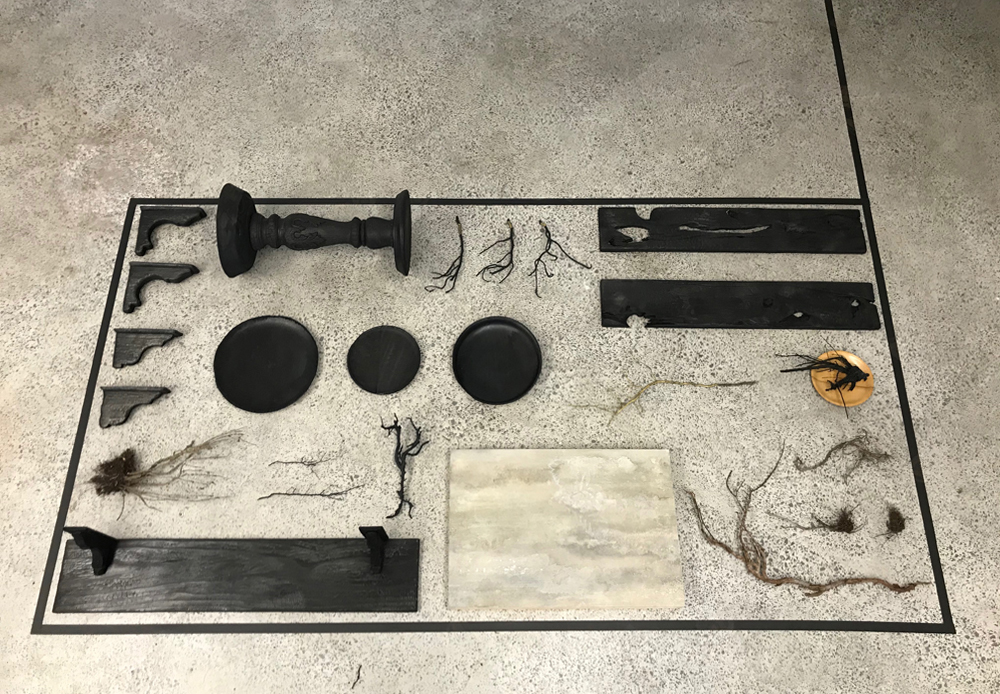
An unsolicited acculturation. Charred non-native timbers, colonial pedestal and domestic ware, root systems, antique gold thread, hardboard canvas, paint, pencil, epoxy resin, screws, matte black tape.
The process of charring timber preserves it. In burning off the more combustible outer surfaces, the wood becomes fire retardant, water resistant and thus less susceptible to decay. This seemingly destructive act is conversely an act of conservation. The technique is a borrowed one; an acculturation, a non-native cross-cultural entanglement.
Weeds are plants out of context; unsolicited flora. Their perceived value altering through shifts in timeline or location. The acanthus, surely the apotheosis of the weed kingdom, entwines its way throughout art history. Its pervasive motif appearing on Greek Corinthian columns, William Morris tapestries and carved colonial furniture. It too has migrated from Western Europe and taken root in Grey Lynn gardens.
Unearthed root systems form a tangible figuration of Nature Morte.
Still life, that liminal space where utility is halted and decay transposed.
In trying to understand and quantify the world around us and our collective place within it, the Western tradition lies in collecting, classifying, storing and displaying.
Botanical drawings exemplify this taxonomical practice.
As Damien Hirst has observed, “ You kill things to look at them.” [1]
[1] Stuart Morgan, interview with Damien Hirst, ‘Life and Death’, Frieze, no.1, Summer, 1991, p.24 as quoted in Forms without Life https://www.tate.org.uk/art/artworks/hirst-forms-without-life-t06657

